
On the one hand, I’m not a big fan of musicals as a genre, but on the other, I very much like the story of Sweeney Todd. Penn State Theatre’s production of Sweeney Todd: The Demon Barber of Fleet Street, directed by Zack Steele, was generally a strong performance, though the night I saw it there were technical issues.
Sweeney Todd is a musical focused on the titular character, who was unjustly transported to Australia by Judge Turpin so that Turpin could seduce Todd’s (or, Benjamin Barker, as he was known then) wife, Lucy. Todd returns to England, consumed with the desire for revenge, especially after learning from Mrs. Lovett that Lucy had taken poison and their daughter, Johanna, has been raised by Turpin. Todd resumes his career as a barber, planning to murder both Turpin and Beadle Bamford, Turpin’s corrupt accomplice. As part of a larger revenge against the corrupt world, Todd begins killing random gentlemen who come into his barber shop, and Mrs. Lovett grinds their bodies up to put in her now incredibly popular and delicious meat pies. As this is going on, the young sailor Anthony Hope, who had rescued Todd from being adrift at sea, has fallen in love with Johanna, and she with him, after they see each other through the window in Turpin’s house where she is confined. Anthony plans to essentially kidnap Johanna so they can run away together, but their plans are repeatedly foiled by Turpin, who decides to marry Johanna himself. Things begin to unravel in Todd and Lovett’s scheme when Tobias Ragg, a young man they’ve employed after Todd killed his former boss, begins to suspect that Todd is a serial killer. The other person who suspects is an old beggar woman, but no one listens to her. Finally, Todd is able to kill both the Beadle and the judge, and he also kills the old beggar. However, when he goes down into the bakery, he discovers that the beggar was Lucy, the wife he thought was dead, and he realizes that in his quest for revenge he’s accidentally killed the person he meant to be avenging. Todd pushes Lovett into the ovens for deceiving him, and Ragg kills Todd. Johanna and Anthony arrive just in time to see Todd die and have the whole serial killing business revealed.
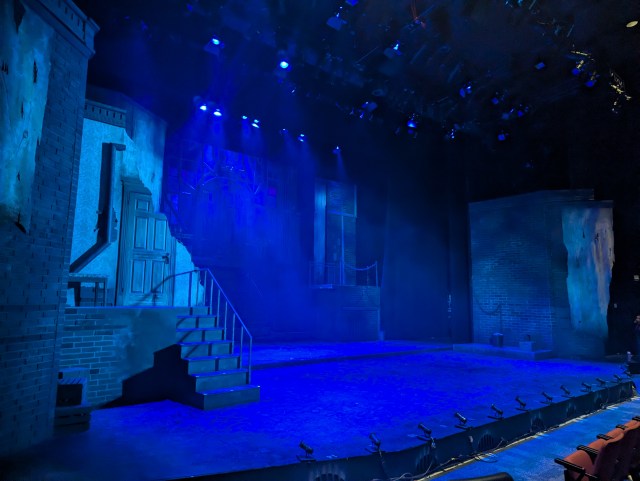
Todd is based in the Victorian British Penny Dreadful craze, which were cheap publications containing sensational stories, often gothic and macabre in nature. This is an aesthetic I really like, and the Penn State production definitely fit that style. Alivia Cross, the scene designer, and Hilary Hayes, who did costuming, created a dark and spooky nineteenth century vibe that reflected the horrors of both Victorian London’s slums and the gothic violence of the Sweeney Todd story. The incompleteness of the set—as seen in the picture included—reflects the kind of spooky and unsettling tone of the shole show.
On the less technically effective side, there was a brief issue the night I went to see the show. Obviously, we in the audience weren’t told what the problem was, but my sense is that there was a power failure to some of the lights. I can’t fault the production for that. But it also seemed to me that the lighting was just off for the show—with the caveat that I was sitting relatively far forward and as far to the left of the house as possible, so it may have been the angle I was watching from. But it seemed to me that performers, especially when members of the ensemble sang solo lines, often stood just outside where the spotlights shone down. I don’t know if this was the actors off their proper marks, or the lights not aligned properly, or just my perception from where I was in the audience.
The performances by the cast were quite good across the board. Since I’m not really a fan of the musical genre, I don’t know enough to properly assess the singing quality, but I was really impressed primarily by Ronnie Spoto’s singing as Anthony Hope. He has a genuinely beautiful singing voice. Other stand out performers included Madeline Glave as Mrs. Lovett, who brought a great mix of comic relief, sinister thrift, and desperate desire for Todd’s affection to the character. Gavin Ditz’s Judge Turpin was a masterful example of that kind of sinister self-confidence of those with money and power who know that they’re unlikely to ever face consequences for their cruelty, hypocrisy, and violence. And, of course, Sweeney Todd, played by Ethan Peterson was a dark and sinister presence throughout the play, suggesting the menacing evil that the character represents.
 Phillip Zapkin