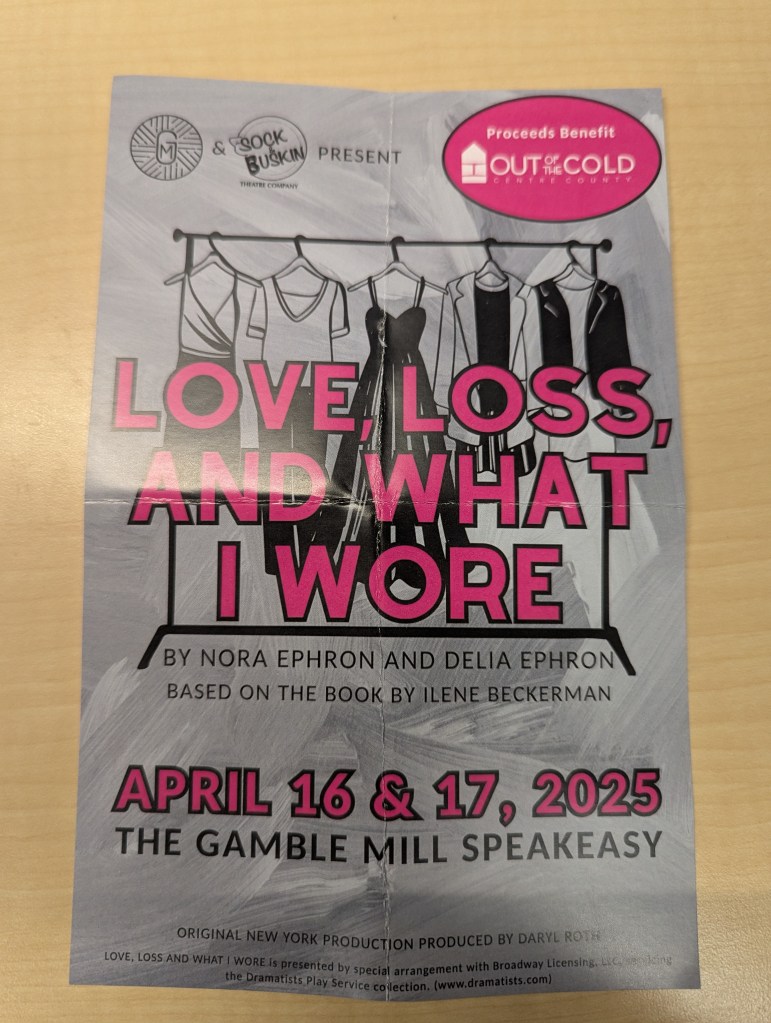
The Gamble Mill and Sock & Buskin Theatre Company co-sponsored a staged reading of Nora and Delia Ephron’s Love, Loss, and What I Wore—adapted from Ilene Beckerman’s novel—as a charity performance to raise money for Out of the Cold Centre County, which is a shelter. The production was directed by Priscilla McFerren.
The play revolves around women’s memories and self-perceptions tied to specific pieces of clothing. In this sense, it’s an interesting exploration of material culture—how we live with specific objects that shape our reality, our worlds, and that reflect on us and our lives. Clothing is an important type of material culture because it reflects things like status, position, ways of being in the world, etc. And women’s clothing is especially significant in a still patriarchal culture like the US (where the women speaking come from), because women’s clothing is tied to issues of respectability, sexuality, status, appropriateness, self-esteem, shame, etc. And these issues are explored through the various monologues, dialogues, and short scenes—often in extremely humorous ways, and sometimes in tragic ones.
A fascinating element of the staged reading was that different performers had to fill different types of roles, meaning that the cast demonstrated a wide range of theatrical talents. This is especially challenging for a staged reading; which may seem counterintuitive to non-actors, since it seems like having the script there to read from would make the performance easier—no memorization necessary—but it’s actually harder to bring a character to life with all their mannerisms, quirks, etc. when you’ve got a script in your hand and need to keep referring back to it.
However, as I said, the cast did a great job working through different approaches to performance within this show. Kristi Branstetter, for instance, had the largest recurring part, playing Gingy, whose story weaves throughout the play as a whole. I believe Gingy’s story is told in six parts. This means that Branstetter got to bring this character back repeatedly, developing her unique style, voice, attitude, etc. over multiple segments.
In a different performance vein, Kristine Allen generally performed longer monologue parts, meaning she had more time to develop individual characters within those monologues. For instance, she had an incredibly funny bit about a woman who absolutely hates purses with every fiber of her being. Because the scene was so much longer than most, and because Kris was the only performer, she really got to build up that character’s distinctive ways of expressing frustration, outrage, and eventual joy when she finds the one bag she actually likes.
The other performers—Jackie Gianico, Alexa Krepps, and Carrie Marcinkevage—mostly played smaller roles (roles with less individual lines, not smaller in importance) and had a lot more dialogue based scenes. Having larger numbers of characters to build offers a different challenge, because it requires bringing a different voice, attitude, stance, etc. to each speaker and making them their own original person. This can translate into a lot of different people to keep straight in a performer’s head. But they managed this admirably, so that each individual speaker felt like an individual, felt like their own person, rather than blending together. Between the tremendously talented performers and Priscilla’s direction, this production rose to and surpassed the challenges of the different acting styles required in Love, Loss, and What I wore.
 Phillip Zapkin