
Typically, I’m not a huge fan of musicals, but Roald Dahl’s Matilda: The Musical, direct by Matthew Warchus at London’s Cambridge Theatre was properly enjoyable. I watched the film version of Matilda as a kid, but I’ve never read the book, so I did have some distance from the source materials, while still having a degree of familiarity. It was also interesting to see this musical with my study abroad students, some of whom are very familiar with Matilda and some of whom didn’t know it at all.
Matilda is about an extremely smart little girl who reads hundreds of books, knows multiple languages, and can do relatively difficult math in her head. However, she inhabits a world peopled by her parents who detest her and abuse her for her intelligence and a school headmistress who hates children and believes devoutly in breaking their spirits and individuality. Matilda herself resists these anti-child forces, though there’s often little she can do to stop the abuse by adults. However, she is joined by Miss Honey, the intelligent but cripplingly insecure teacher, and to a lesser extent by Mrs. Phelps, the librarian who loves to hear Matilda’s stories. Eventually, with the rest of the children on their side, and a very brief appearance by Matilda’s otherwise never-mentioned telekinetic powers, Matilda rights the wrong done to Miss Honey by the headmistress Miss Trunchbull (who murdered her parents and took her family home), and ends up saving her parents from the Bulgarian mafia, for which she is rewarded by her father agreeing to let Matilda stay with Miss Honey as they flee for their lives.
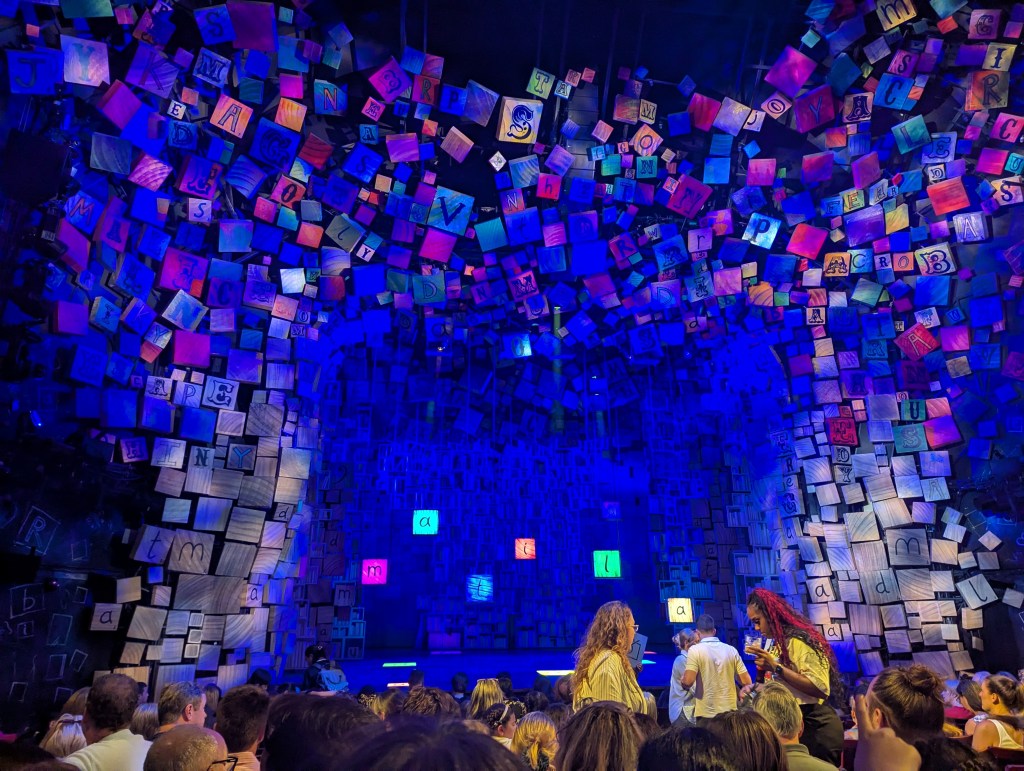
The Cambridge Theatre production was a high energy performance, very appropriate for a children’s show, with a lot of big personalities, bright colors, and fast songs. Some of the choreography was especially impressive, like in the number “School Song,” during which performers pushed alphabet blocks into metal slots in a set piece while other performers leapt from block to block, all while singing a song that went through the alphabet in order as each block went in. The coordination, amount of rehearsal time, and skill that goes into such a smooth sequence has to be extremely intense.
The show also runs on an economy of outsized characters, which is partially driven by the fact that Matilda is a child and we’re seeing these events (at least to a certain extent) from her perspective, and partially driven by the fact that this is a comedy. Some of the biggest personalities came from Matilda’s family, especially her skeevy used car salesman father, Mr. Wormwood (Neil McDermott), and her chav dance competition-obsessed mother, Mrs. Wormwood (Tiffany Graves). Mrs. Wormwood even has a number called “Loud,” during which she and her faux-Italian dance partner Rudolpho (Sam Lips) chastise Miss Honey (Eve Norris) for being too timid.
And yet, there are these wonderful quiet moments in the show, which contrast the loud, fast, bright musical numbers, producing a great balance. Most of the quieter moments focus on Matilda (I don’t include children’s names in performance reviews) and/or Miss Honey. For instance, in the number “Quiet,” Matilda sings alone, even as much of the ensemble, Miss Honey, and Miss Trunchbull (Kieran Hill) are in the background moving in slow motion. This song is accompanied primarily by low chimes, aligning well with the theme of an inner peace settling over Matila as she comes into her telekinetic powers. And the subsequent number is “My House,” in which Matilda joins Miss Honey in the shack where she lives, learning that he teacher has been dispossessed in questionable circumstances by Miss Trunchbull. This is Miss Honey’s quiet song of defiance, where she asserts that the place she lives is not much but it is her home.
My one critique of the show is that Miss Trunchbull was played by a male actor—though this is not unique to this production, but seems to be consistent with the show across different performance venues and with different actors in the role. Certainly, Hill himself was quite good in the role, playing the severe and cruel Miss Trunchbull in a way that was simultaneously funny and intimidating. But the long history of queer-coding villains in media has played a role in the demonization of LGBT people, and especially in a comedic venue for children, it does raise ethical concerns about the nature of that representation.
 Phillip Zapkin