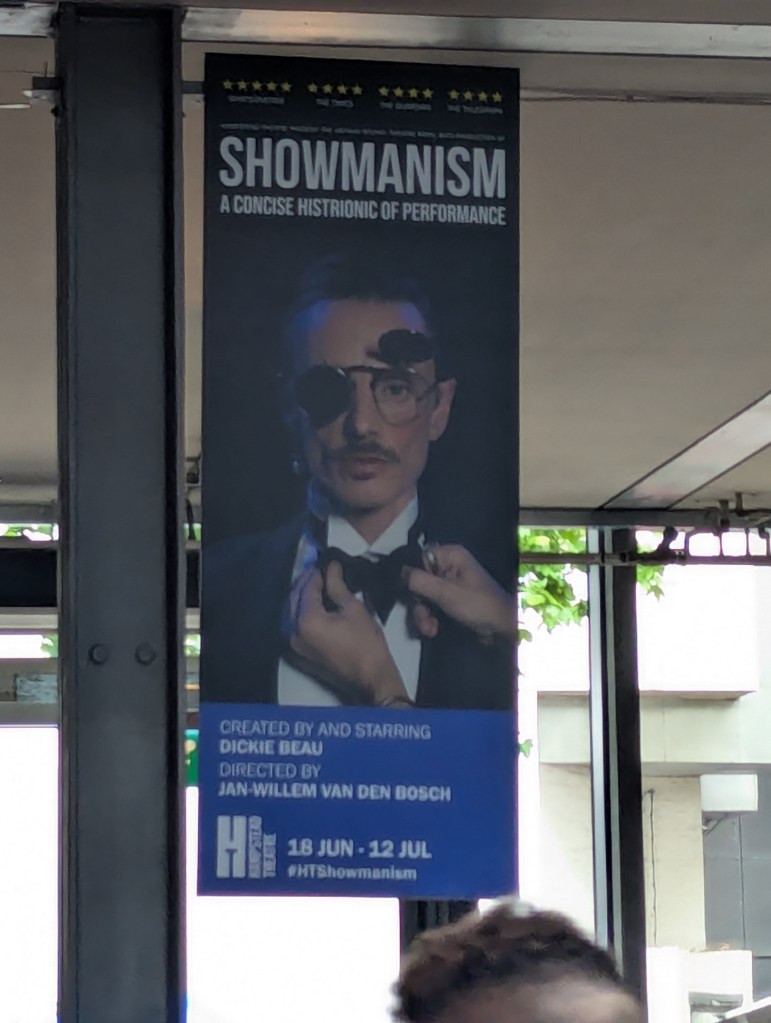
I wasn’t sure what I was going to make of Dickie Beau’s one-man show Showmanism: A Concise Histrionic of Performance, directed by Jan-Willem Van Den Bosch at London’s Hampstead Theatre. I knew very little about the show before it started, apart from it being a one-person show (which can sometimes be quite disappointing) and that it was generally about theatrical anecdotes. But I found it absolutely stunning. I believe I was one of maybe two-three people who gave Beau a standing ovation. To a certain extent, I almost expect it will be the one of the eight plays I’m seeing in London over this month that I will keep coming back to and thinking about going forward.
The play itself seems based on recordings Beau did with famous theatre personalities like Sir Ian McKellan, Peter Sellars, and Fiona Shaw, to which Beau lip synchs, primarily taking their roles. The subject matter ranges fairly widely, but generally focuses on what the theatre means, what it means to perform, how we build identities through performance, how we obscure identities through performance, etc. As the performance jumps through different speakers—sometimes quite quickly—Beau physically changes how he holds his body and presents himself, giving a physical personality to each of the voices, and he goes through different actions that have some kind of symbolic resonance.
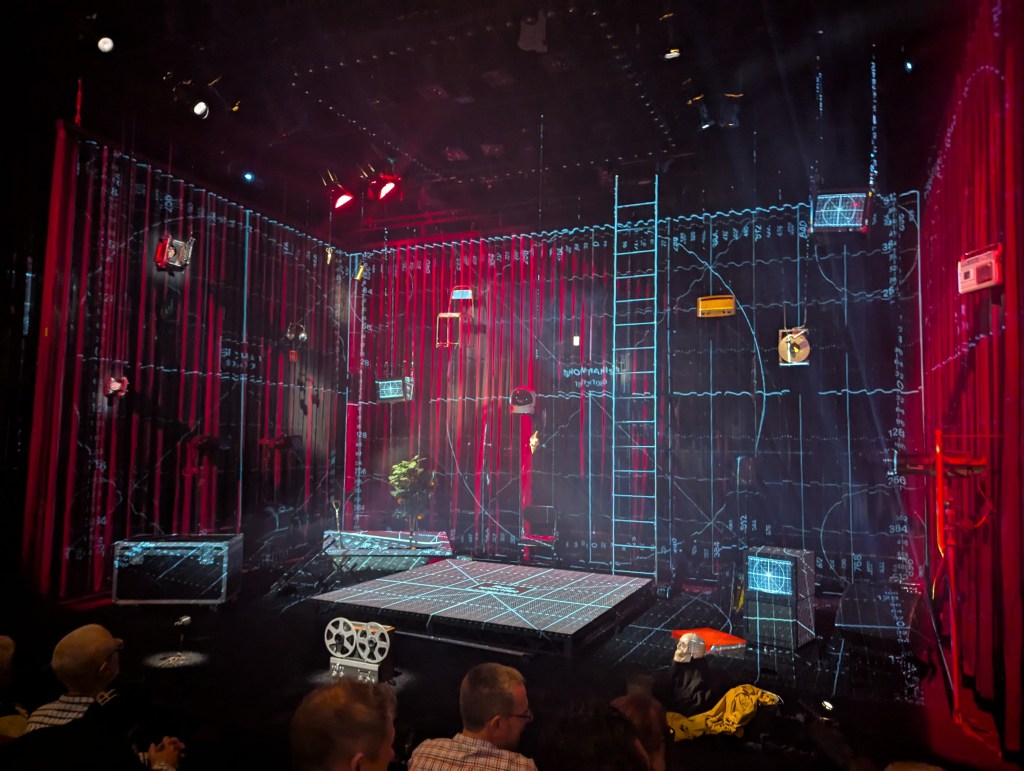
Perhaps the element I found most interesting was the tension in the show between theatre as a space of seeing vs. hearing. The show opens with a discourse on the combined Biblical passages John 1:1 and John 1:14 (respectively): “In the beginning was the Word,” “And the Word was made flesh.” There’s a meditation on the nature of language as a mode of communication that quickly superseded all pre-existing forms, and the show posits (or raises the possibility of) a divine aspect to acting in that through the process of acting, the words of a script are made into the flesh of the actors. This question about the divine inspiration of or central nature of acting and theatre returns in various forms through the production—making the title Showmanism an appropriate play on shamanism, or the spiritual lead of a figure attuned to mystical or divine energies. And the notion of the Word as definitive—as Ian McKellan says in the recording, you need the script, if it’s a play—connects in really interesting ways with this play in itself, because virtually everything we hear is pre-recorded. Beau doesn’t directly speak in real time in the play, and there are plenty of sound cues. But at the same time, even as the recorded voices discuss how Greek amphitheatres were designed as “sound machines” so that audiences could hear plays, we cannot escape the contradiction that, although we’re hearing recorded sounds, that makes this play is Beau’s physical presence, which functions entirely at the physical level. Beau mimes, he dances, he changes costumes (spending much of the time in his underwear), he engages with props, he alters his posture, etc. And without seeing Beau perform these actions, the recordings themselves could be listened to, but it would be a much more hollow show.
A close second for thematic interest is the question of identity in the theatre. Early on in the show is introduced the famous opening line of Hamlet: “Who’s there?” And this becomes another central thematic nexus. In part, this question is dealt with through the recorded voices themselves, who frequently discuss what acting has revealed to themselves about themselves, or how acting has become an escape from themselves, or even moments when acting takes them out of themselves and transports them (on some level) to a different time and place—like, I believe it was Fiona Shaw speaking about performing in the theatre at Epidaurus and sensing the link between herself and the ancient Greek performers of 2,500 years before. But the theme of identity is also picked up in regards to Beau himself, whose own identity, subjectivity, and even self are—perhaps—repressed within this performance. He is, after all, performing primarily other people, and for much of the show whenever his own voice comes on the recordings he remains in character as the other person. This, of course, raises interesting philosophical questions about what it means to perform as others and leave out performing as oneself. Of course, all performance involves—to a greater or lesser extent—stepping out of one’s own identity and into another, but Showmanism specifically raises questions about what that means in terms of one’s own identity and the process of identity formation/construction.
Lastly, on the level of performance itself, I was extremely impressed by Beau’s physical presence on the stage and his abilities to morph between different personalities and to perform nearly continually throughout the entire show. Acting is often physically tiring, and Beau had to go through multiple rapid on-stage character changes, which is an extremely difficult thing to do because it requires a different mindset and different physical presentation. Typically, with something like double-casting, where an actor plays two (or more) parts, the transition takes place off stage, but here the transitions were done in full visibility of the audience, meaning also that Beau didn’t have time to center himself and step into the headspace of each new role, it needed to happen almost instantaneously, which is incredibly challenging from a performance perspective. But he pulled it off amazingly well, which to me shows what an incredibly talented performer he is.
 Phillip Zapkin