
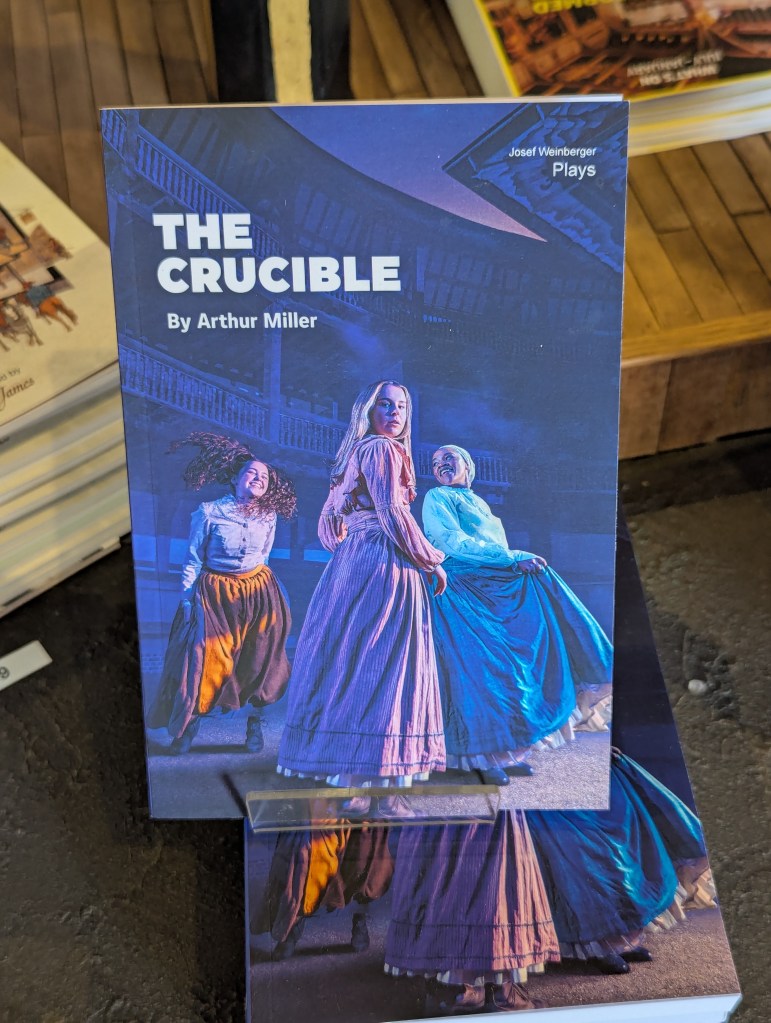
Arthur Miller’s classic anti-McCarthyite play The Crucible is widely regarded as one of the most important plays of the twentieth century, taking a stand against the injustice that comes with authoritarian injustice and religious fanaticism. But it’s also a deeply problematic play. And the choice by Shakespeare’s Globe to put it on in 2025, under Ola Ince’s direction, seems like quite a pointed one.
The play focuses on the struggles of John Proctor, a farmer on the outskirts of Salem, MA, who is drawn into a witch hunt when his former servant and lover Abigail Williams is caught by her uncle, the Reverend Parris, dancing and doing rituals in the forest with a bunch of other girls. Abigail quickly realizes that she can get out of trouble and increase her power, standing, and reputation in the town by accusing others of witchcraft. The girls—headed by Abigail—essentially start a reign of terror, in which any accusation effectively translates into a conviction, and the accused can only either confess to witchcraft (which carries a prison sentence) or deny it and be hanged. Still carrying a torch for John, and apparently believing that he wants to marry her, Abigail accuses Elizabeth Proctor, John’s wife, in an attempt to have her judicially murdered. But when John rejects Abigail and confesses their affair to the court to destroy her reputation, Abigail turns on him and accuses him of witchcraft as well. When Elizabeth—not knowing about John’s confession—refuses to tell the court about his adultery, she seals his conviction. The Reverend Hale, who initially came to Salem and began investigating demonic activity is increasingly horrified by the authoritarian fanaticism of the high court, in which there is no defense that can be plausibly made once one is accused. And when John is condemned, Hale turns against the court, being convinced of John’s basic goodness. Now both prisoners, Elizabeth refuses to ask John to falsely confess, but he determines to because of his guilt about the affair with Abigail. However, when the high court judge demands he sign the confession to be posted on the church door, John refuses to have his signed name publicly posted, recants his confession, and goes to the gallows.

The Globe’s performance was very good, as I would typically expect from The Globe. There are a number of moments of high tension, high emotion, and big speeches in The Crucible, and the actors really went for them full bore. Gavin Drea’s John Proctor continually showed his emotions, barely attempting to hide his frustration, rage, and fear for his wife. Although Puritan New England would likely have generally preferred a minimum of emotion, Drea made the character the central figure through his performance—and on a personal note, I really enjoyed his Irish accent in the role. Similarly, Jo Stone-Fewings gave an excellent performance as Rev. Hale, playing the part with deep dignity, solemnity, and an amazingly performed transition from absolute certainty in the righteousness of his actions to a deep doubt about the whole witch-hunting enterprise.
And as much as there were great emotive performances of these serious, heavy roles, The Globe also balanced the production with humor, particularly through Howard Ward’s performance as Giles Corey. Corey is an irascible farmer, prone to lawsuits, and Ward regularly drew laughs with his performance of the often bumbling, yet deceptively sharp old man.
For me as an individual viewer, I have a very difficult time now watching The Crucible as I think Arthur Miller would have wanted it watched, in large part because of the criticisms of John Proctor developed in Kimberly Belflower’s play John Proctor is the Villain, which quite correctly points out that Proctor is terrible to his wife. He cheats on her, becomes verbally/emotionally abusive when she does not sufficiently forgive him, centers himself in all of their discussions, even when the discussion is ostensibly about her, and ultimately chooses to die for “his name” rather than lie to survive for Elizabeth and their children. Of course, John could not have known that the witch trials were coming to an end and he likely could have survived with a minimum of inconvenience, but he nonetheless made that choice to protect an arbitrary understanding of “his name,” not even his reputation, not his soul, etc.
But beyond this, Miller clearly structured The Crucible as a tragedy, in which a basically good tragic hero—and we’re told over, and over, and over that John Proctor is a good man—has a tragic flaw, which condemns him to suffer, before there’s a cathartic purging of emotions. (In the 1950s, when Miller wrote this play, a common understanding of the Greek concept of hamartia was a tragic flaw, though it’s now generally understood as a tragic error). John’s tragic flaw is his pride. And in this sense, it’s a flawed tragedy, because John remains constantly motivated by that pride—there is no revelation in which he realizes that everything fundamentally has happened because of his flaw. Instead, he embraces that flaw from beginning to end: his affair with Abigail reflects his prideful sense of entitlement and willingness to give into his lust, his demands that Elizabeth sufficiently forgive him reflect his prideful need to be seen to have repented, his condemnation of the witch-hunts (while justified) reflects his prideful independence from the church (which, of course, Puritan New Englanders would not see positively), his confession is motivated by a prideful sense that he’s not ethically good enough to be executed with the other prisoners, and his recanting of his confession is his prideful desire to keep his name from being nailed to the church even if there were no stakes for that physical act being done. Ultimately, despite Elizabeth’s final statement that John “has his goodness back,” it’s not clear that his fundamental motives in going to an unjust execution are any ethically better than his worst actions in the play.
 Phillip Zapkin