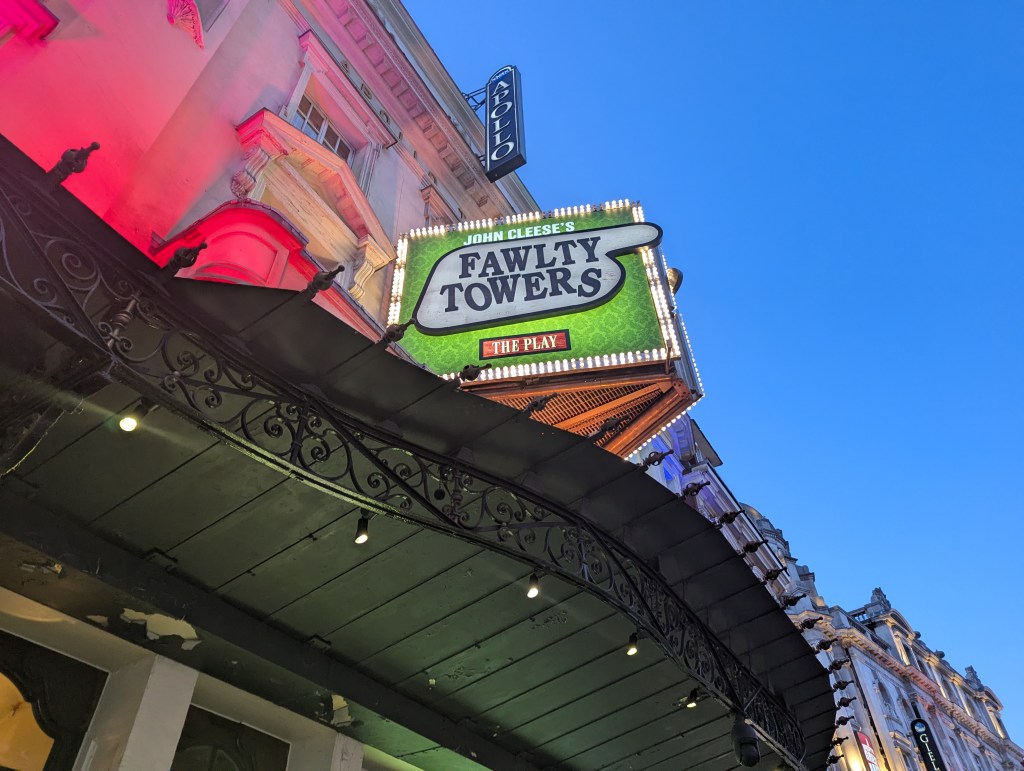
John Cleese’s stage version of Fawlty Towers is a striking adaptation of the beloved 1970s sitcom of the same name, in which Cleese starred and which he co-wrote with Connie Booth (who played Polly in the original). What makes the stage version—premiering in 2016—so fascinating for me is what it does and doesn’t do, and how that reflects a specific position within larger culture.
Cleese’s stage adaptation, like the TV show before it, follows the misadventures of Basil Fawlty, who owns (with his wife Sybil) Fawlty Towers hotel. Basil is misanthropic, constantly frustrated by the guests, the staff, and his wife who (in standard 1970s sitcom fashion) henpecks him continually. Basil is constantly trying to get ahead, succeed in his business, and surreptitiously make money on the horse racing that Sybil has forbidden him. And yet, his constant frustration, flapping about ineffectually, and angry outbursts undermine his ability ever to move forward in any way. Much of the humor is driven by the gap between Basil’s stated desires and how his actions undercut achieving those desires. Simultaneously, the humor is rooted in depictions of English parochialism, prejudice, etc. which often involve physical abuse of the Spanish waiter Manuel, anti-German discourse surrounding WWII, etc.

The play draws on several episodes from the original 1975-79 television show, reproducing them extremely directly. There is virtually no new dialogue, no new plots/conflict, no new characters. And the performers sought to reproduce, as exactly as possible without the original cast and in a single set rather than multiple individual sets, the styles, mannerisms, inflections, etc. of the original cast. Essentially, the stage show sought to construct a facsimile of the television show. Danny Bayne, playing Basil, reproduces the mannerisms, physical comedy, inflection, and tone of John Cleese from the original, mirroring the original performance with its iconic recognizability. This facsimile quality is apparent from the very beginning of the show, when Mia Austen (Sybil) gives the iconic loud, obnoxious laugh of Prunella Scales when speaking on the phone to her friend. For audience members familiar with the original, this laugh immediately signals the reproduction of the original.
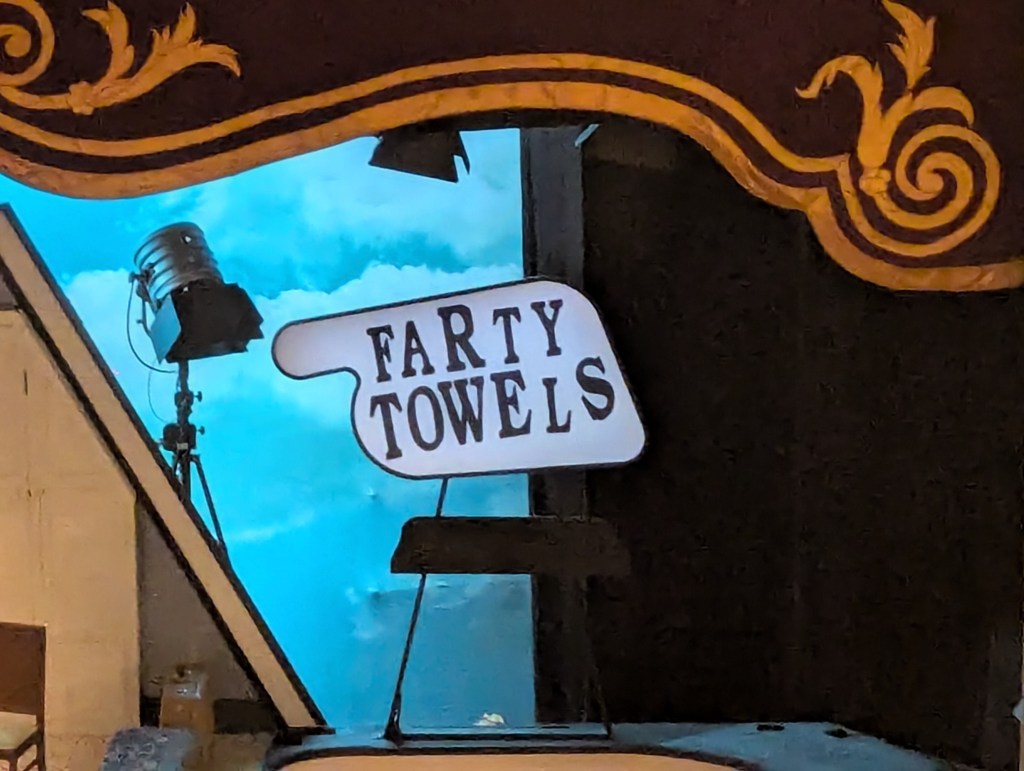
What makes this dramaturgically interesting is the question of what this facsimile quality means for the play as an artistic endeavor. The attempt to reproduce exactly this earlier version of the story is, on the one hand, rooted in an appeal to audience nostalgia. From the perspective of ticket sales, reproducing a beloved intellectual property will come with a built-in audience—this is the entire foundation of the British culture industry, why we get so many film and TV versions of Austen, Bronte, Dickens, etc. And especially with something like Fawlty Towers, which so many middle-aged/older British people grew up with, there will be large numbers of potential audience members who want to relive a beloved show of their youths. This partially explains the wide-ranging tour that this production run is going on, bringing this show from London’s West End to a number of small villages and towns that normally would not be included in a theatre tour of this type of production. If you want to sell tickets, it’s not a terrible strategy to give people something they already know and love, without challenging their love for it.
At the same time, John Cleese’s star has somewhat faded in recent years as he’s settled into being an older comedian “from a different time,” with the attendant slightly-out-of-step-with-contemporary-sensibilities that goes with that. And so there may be an element of Cleese wanting to revive an IP in which he was clearly the center piece (as opposed to something like Monty Python, which was much more an ensemble project) and was beloved. In this sense, resurrecting Fawlty Towers as it was in the 1970s—even if Cleese himself isn’t on stage—is a kind of return to his glory days, and can be seen as a signal to modern sensibilities that “real people” want the kind of moderately offensive entertainment that was standard fare in 1970s sitcoms.
And this raises an interesting question about whether we extend grace to the stage version of Fawlty Towers. I mean, when we watch the original show, it is clearly an artifact of the 1970s—it has those attitudes, that style of humor, views from the time, etc. We may today find them inappropriate or problematic, but we accept that it was pushing the envelope without being unacceptable in an earlier era. But the tricky issue becomes whether we can/should see the 2016 stage version as an artifact of the 1970s. In the sense that no new words have been written, it does belong to the 70s and perhaps should be seen with the same kind of toleration as the original show. But in the sense that Cleese elected, in 2016, to use the raw materials from the 1970s without making changes to align better with contemporary sensibilities, it must be regarded as a modern piece throwing back to 1970s values and humor, and we can judge it for being out of date in that sense.
 Phillip Zapkin