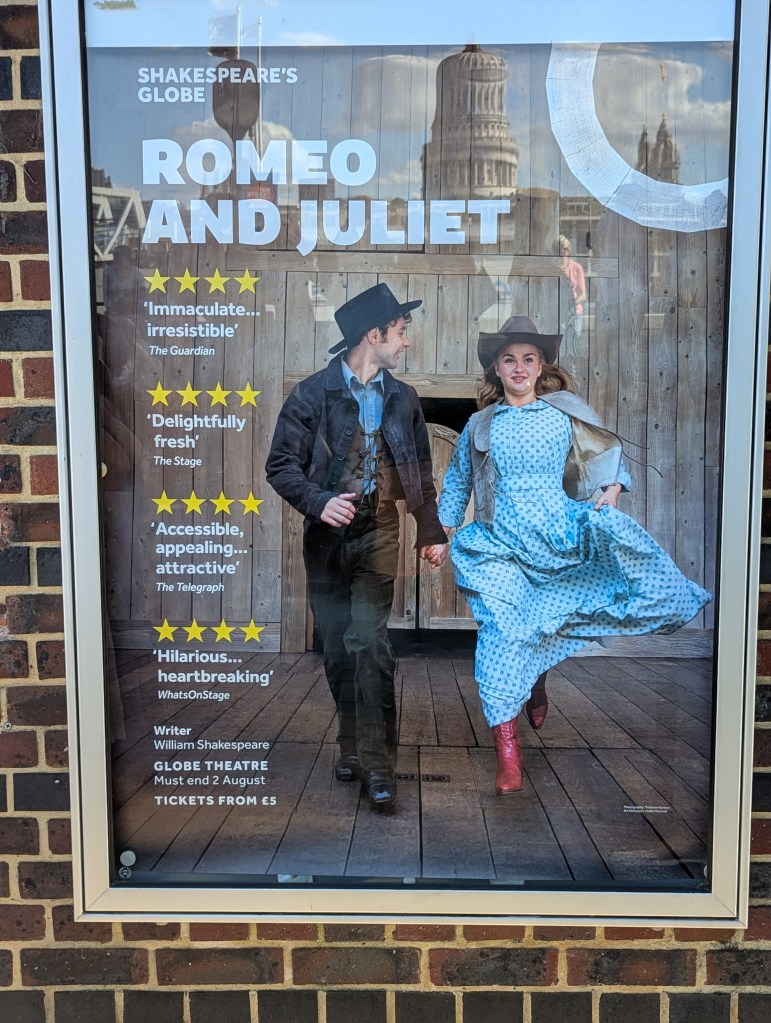
Shakespeare’s Romeo and Juliet is one of those plays that is incredibly famous, but also quite easy to hate: because so many of us are forced to read it in school, because so many people think of this story of teenage angst and suicide as the ultimate love story, even because the characters themselves aren’t particularly sympathetic at the end of the day. This was kind of my take on the production by Shakespeare’s Globe, directed by Sean Holmes. The performance wasn’t bad, but it was not good enough to overcome my qualms about the play itself.
The story of Romeo Montague and Juliet Capulet centers around their family feud, which leads to violence in the streets of Verona whenever the warring factions encounter one another. However, when Romeo and his mates crash a Capulet party, Romeo and Juliet fall in love with one another, not realizing that they are the only children of rival households. Upon discovering that they are ancient enemies, the lovers set aside their enmity and risk their families’ displeasure by marrying in secret. But when Juliet’s cousin Tybalt picks a fight with Romeo in the street, Romeo is unable to defuse the situation, leading to Tybalt killing Romeo’s friend (and the prince’s cousin) Mercutio and then Romeo killing Tybalt. For this, Romeo is banished. He is only persuaded out of killing himself by Friar Lawrence, who—quite straightforwardly—points out that Romeo can eventually appeal the exile and return to Verona and Juliet. However, Juliet’s father determines that she must marry Paris, a nobleman, whether she wants to or not. So, Friar Lawrence develops a plan in which she will take a potion to simulate death for forty-two hours, then she will awake in her family crypt, where Friar Lawrence and Romeo will be waiting to take her to Romeo’s exile in Mantua. However, Romeo never gets Friar Lawrence’s message because Mantua is closed due to fears of the plague, but he does learn of Juliet’s supposed death from his friend (who apparently got into the city despite fears of the plague). Romeo returns to kill himself with Juliet’s corpse, encounters and kills Paris, and then poisons himself. Juliet awakes, finds Romeo dead, and stabs herself. Then the prince, the surviving Capulets and Montagues, and Friar Lawrence all show up, and the prince basically ends the feud by executive order.
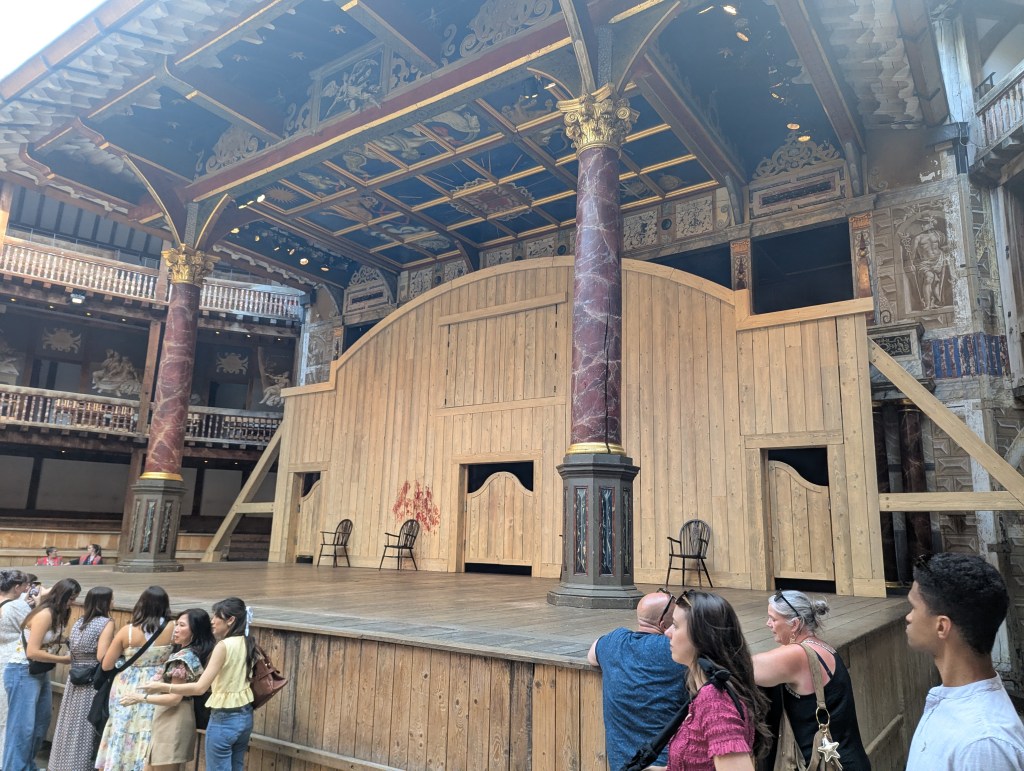
The Globe production of Romeo and Juliet had a “wild west” aesthetic, with people in old west clothing, carrying Colt Peacemakers, square dancing, and a bluegrass-inspired band. On the level of straight-up aesthetics, this is totally fine. It works as a coherent design schema. However, any setting after around 1850 exacerbates the fundamental flaw in the conceit that leads to the titular characters’ suicides. Even in 1597, there’s a logical problem, in that Friar Lawrence’s messenger can’t get to Romeo in Mantua because the city is closed to avoid plague, but Romeo’s buddy just strolls into the city apparently unchallenged. It’s not entirely clear why Romeo’s friend can get into the city to deliver his message, but not Friar Lawrence’s guy. And this issue becomes more pronounced with any broadly modernized setting, because instantaneous communication becomes possible. If this is set in the 1880s or 90s, why doesn’t Friar Lawrence just send Romeo a telegram? He could get the message to Romeo instantly, and plague concerns would have no bearing on anything.
The two performances I really enjoyed in the Globe production were Mercutio (played by Michael Elcock) and the Nurse (played by Jamie-Rose Monk). They were both consistently hilarious, which seemed to be a big part of what this performance was going for. Elcock did great crowd work, especially engaging with people standing right at the front of the stage for comic bits, like references to the dreams of maids or parsons, for which he would pick out a spectator to be that type of person. And Monk played the Nurse incredibly well, performing her as a kind of almost-cockney character who continually kept speaking even when inappropriate, which worked really well given Monk’s comic timing.
I also thought it was insightful and interesting how this production played the ghosts of Mercutio, Tybalt, and Paris. The death scenes were hammed up (except Paris, who seemed to die relatively quickly and straightforwardly), which I generally didn’t care for, especially since as an audience member I didn’t have the same kind of shock and horror the surviving characters were meant to have. But, interestingly, Mercutio delivered his famous lines “a plague on both your houses / They have made worm’s meat of me” after his death. So, instead of Mercutio delivering these lines and then dying, his ghost/spirit delivers the repudiation. Subsequently, when Juliet is in the crypt, her feigned dead body dances with the corpses of Mercutio, Tybalt, and Paris; and the living Romeo dances with the seemingly dead Juliet, then the living Juliet interacts with the dead Romeo. Strikingly enough, Romeo’s ghost/corpse offers her the knife with which she kills herself, even holding the blade for her to throw herself onto. If that’s not a metaphor for male violence against women, I don’t know what is.
 Phillip Zapkin