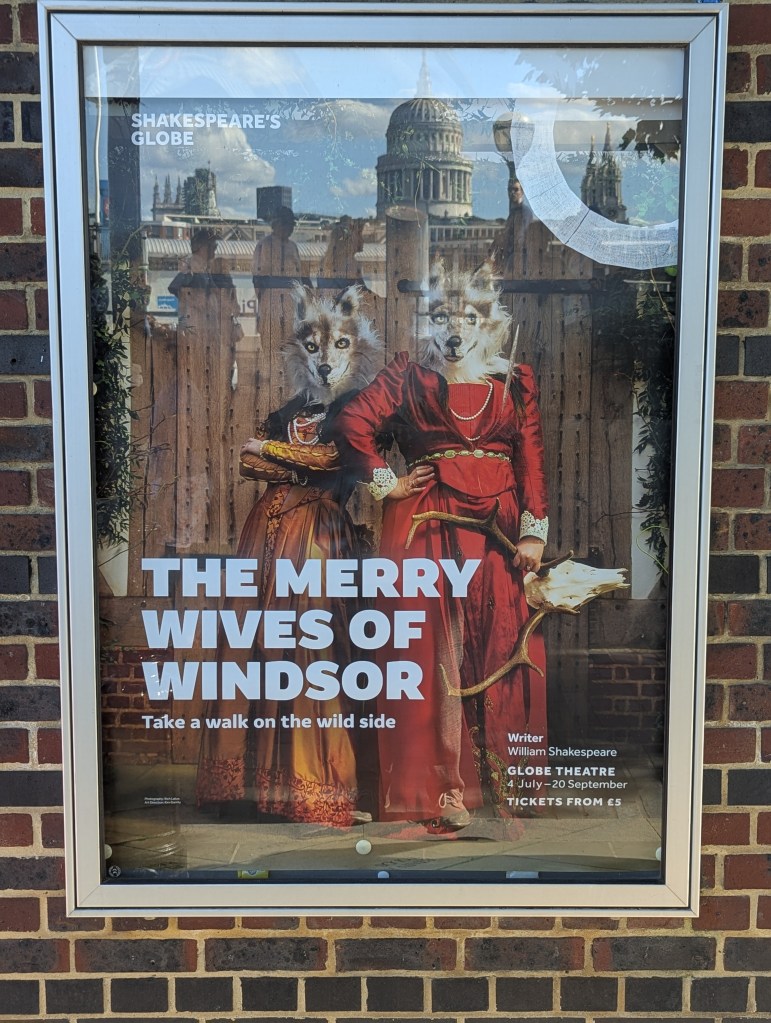
It was a wonderful coincidence when Shakespeare’s Globe posted their 2025 summer season, because they were doing Merry Wives of Windsor, which I had already decided to teach for my Literary London course. This followed them doing Richard III in 2024, while I was teaching that play. It was more surprising, however, that they are doing Merry Wives this year, since the play isn’t put on that much. However, under the direction of Sean Holmes, the production was very good.
The high plot of Merry Wives focuses on Sir John Falstaff pursuing Mistresses Ford and Page, trying to both seduce them and get access to their husbands’ money. The wives, for their part, decide to punish Falstaff by giving him false hope and then humiliating him, which they do twice by having him nearly caught in the Ford house and only escaping by being put in a hamper of dirty laundry the first time and dressed as a woman the second. While in the laundry basket, Falstaff is dumped into the Thames, and when dressed as a woman he’s beaten by Ford, who hates to woman they pretend Falstaff is. Alongside punishing Falstaff, the wives also punish Ford for his jealousy and distrust of his wife by tricking him into thinking Falstaff isn’t there, which humiliates Ford in front of his friends. For his part, Ford tries to test his wife’s fidelity by pretending to be Brook and basically bribing Falstaff to seduce Mistress Ford. Finally, when all these plots are revealed to Ford, Page, and the other members of the town, they decide to finish punishing Falstaff by luring him to the woods at midnight and having a bunch of children pinch and burn him before collectively mocking him back to Windsor. Simultaneously, the main low plot revolves around three suitors all pursuing Anne Page: the wealthy but foolish Abraham Slender (Page’s preferred candidate), the educated but also somewhat foolish and choleric Doctor Caius (whom Mistress Page favors for the match), and Fenton the impoverished noble and former tavern companion of Henry IV’s riotous Prince Hal (beloved of Anne herself). They compete for Anne’s hand, launching plots and squabbling amongst themselves before, finally, Anne and Fenton end up married.
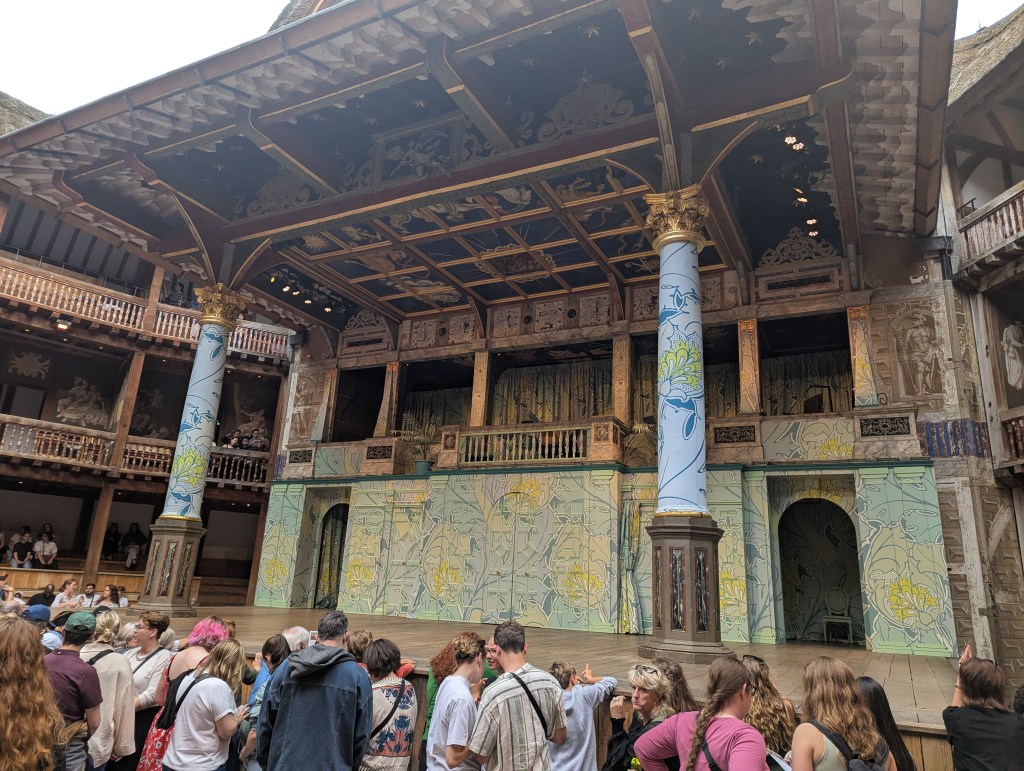
The Globe production was very well acted overall, doing a great job of conveying the humor of the play, which can be difficult with early modern English (though audiences going to the Globe probably have some sense of Shakespearean style—on the other hand, many groups of schoolkids, etc., are forced to go, so they may struggle more). Mike Grundmann, our EF Tours field guide, said that the production had a flavor of the British pantomime—a form somewhat like vaudeville or music hall comedy. The big performances and ridiculous excess of gesture, intonation, and caricature, etc. worked really well for a Shakespearean comedy.
Of course, Falstaff is one of Shakespeare’s greatest comic characters, and so it was incredibly important that George Fouracres played him extremely well. The costuming did not make Falstaff excessively fat—as some productions do—but he was costumed as big enough that the continual jokes about Falstaff’s volume didn’t fall flat. But Fouracres himself did really well playing the heightened emotions of a sometimes jubilant, sometimes lustful, and often suffering Falstaff. There were also hilarious performances from Jolyon Coy as Ford, particularly when he searched the laundry basket for Falstaff in the second attempt to catch the knight in his house. After having servants empty out all the clothes, Coy rushed across the stage and leapt straight into the basket to search it, disappearing entirely withing the basket in a single go—a feat which drew a round of laughs and applause from the audience. Another consistently funny performance was Sophie Russell’s Mistress Quickly, in which she played the comic timing of Quickly’s malapropisms and contradictions perfectly. One interesting and unique element of this performance was that Mistress Ford (Katherine Pearce) seemed genuinely to like Falstaff and possibly to be open to an affair with him—which, of course, complicates the issue of Ford’s jealousy, as it is justified if his wife wants to cheat on him. The only hint in the text that seems to justify her potential desire for Falstaff is when Falstaff reports to Brook that the two of them “had embraced, kissed, protested, and, as it were, spoke the prologue of our comedy” (3.5.75-77). But there’s nothing in the text that prevents this from being a lie told to give Brook hope of seducing Mistress Ford. However, the Globe production chose to have Mistress Ford and Falstaff make out multiple times (though Falstaff also kisses Brook at one point, in a decision even less textually justified), and for her to regularly look at him admiringly or sympathetically. She even comes out at the end of the play, as a beaten, burned, and humiliated Falstaff is limping off stage, and she gives him a final kiss. The decision to make the affair seemingly real—only cut off by Mistress Page trying to stick to the plan and by Ford’s continual interruptions—definitely works as a performance choice, but it isn’t something I see as grounded in the text itself, so it was very interesting to have that version performed.
 Phillip Zapkin