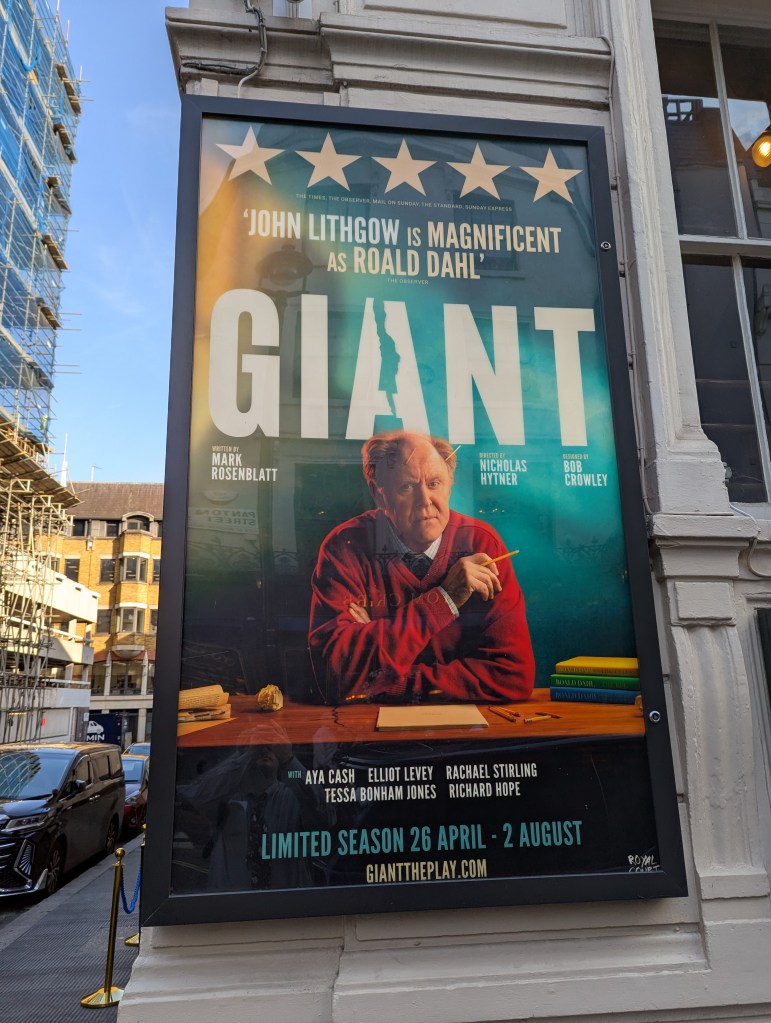
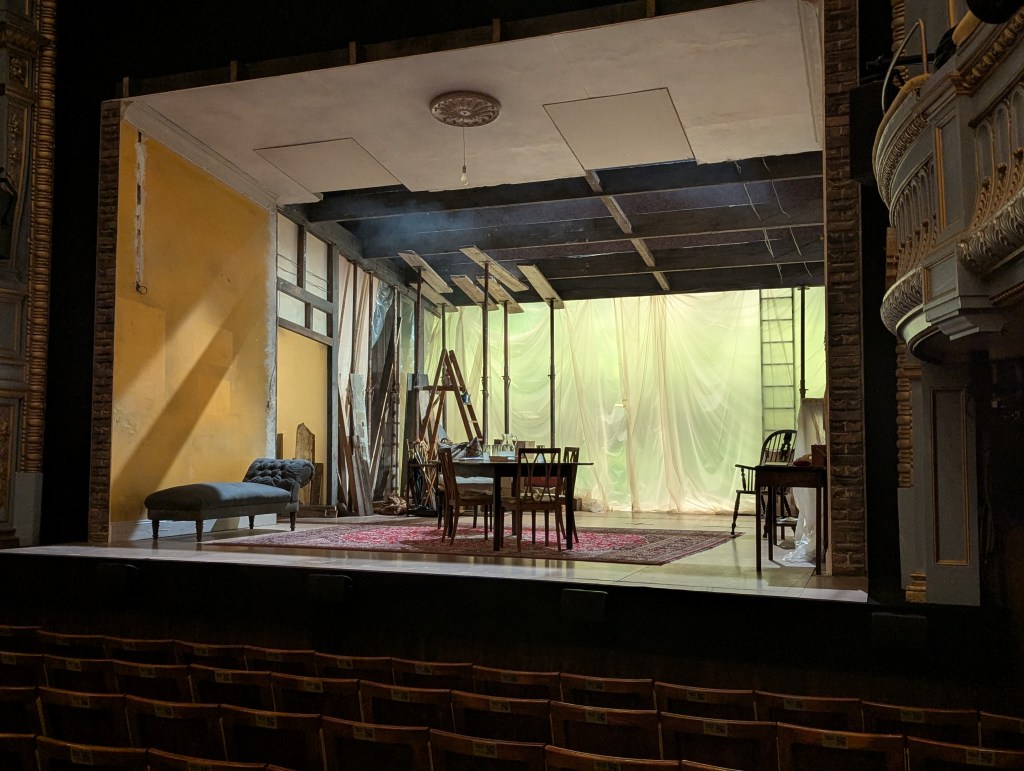
I wasn’t sure what I was going to think of Mark Rosenblatt’s Giant, performed at the Harold Pinter Theatre under the direction of Nicholas Hytner. It was the play selected by this year’s Comparative Drama Conference, and I attended on a ticket through the conference. Since I don’t know much about Roald Dahl—the protagonist of this play—it’s probably not something I would have elected to attend myself. However, it was quite a spectacular way to round out my month of theatre-going in London.
The play focuses on a controversy surrounding Dahl shortly after an anti-Israeli review of Tony Clifton’s book God Cried, about the Israeli siege of Beirut in 1982. Dahl’s comments critiqued not only Israel but implicated Jews as a whole, arguing that unless Jews around the world rose up to somehow stop Israel, we are all bloodthirsty murderers. The problem Dahl faced was that many in the press and the book trade (which disproportionately attracts Jews, as “people of the book” with a long history of valuing literacy and careful textual study) took Dahl’s comments to be antisemitic, and his refusal to apologize, walk the comments back, or even acknowledge that Jews in general or Israelis specifically may have a legitimate perspective further aggravated the problem. Dahl’s British distributer Tom Maschler and Jessie Stone, a representative of his New York distributor, attempt to persuade him to apologize or at least moderate what he said, but Dahl asserts in absolute terms the righteousness of his position, while reducing Stone’s legitimate concerns about boycotts and dropping sales to her own Jewishness. Maschler is also Jewish, but less concerned with Israel and politics, apart from whatever’s politically expedient to sell books. But Stone does genuinely support Israel, and Dahl seizes on this fact to deny the legitimacy of both of their concerns about book sales, all while increasingly falling into more and more paranoid antisemitic conspiracy theories and uglier and uglier anti-Jewish stereotypes and insults. As all of this is happening, Dahl’s fiancé Felicity Crosland tries to mediate, struggling to reconcile Dahl’s personal and financial/literary interests.
If I had done any research on the play beforehand, my expectations probably would have been raised (so perhaps it’s a good thing I went into the show knowing comparatively little, since I got to be extremely pleasantly surprised). Starring the absolutely incredible John Lithgow as Dahl, the show won Olivier awards for best new play, best actor (Lithgow), and Best Supporting Actor (Elliot Levey, playing Maschler). It also features Rachael Stirling as Crosland, whom I’ve seen in several TV shows, and whom I quite like. The same goes—perhaps more obviously—for Lithgow, whose work I’ve seen for years.
Lithgow in particular really drives the show, which is perhaps inevitable for a play centering on a figure like Roald Dahl. Dahl was a big personality, and because his writing has such a massive influence on children especially, he occupies a very important cultural niche. And Lithgow played him extremely well, showing an acerbic wit and quick command of language that drew repeated laughs from the audience. Lithgow brought his trademark facial expressiveness and use of quickly changing expressions to drive the humor, alongside the sharp witticisms of the script. However, Lithgow also brought a darker, more menacing edge to Dahl, especially in the later portion of the play when he increasingly embraces the label of antisemite and begins to traffic in ugly stereotypes. In an episode near the end, Dahl is on the phone to a reporter and blithely discourses negative descriptions of Jews, even concluding that “even a stinker like Hitler” must have had some legitimate reason for hating Jews. While saying these lines, Lithgow plays Dahl as though he’s completely unaware of how horrendous and bigoted his statements are, as though they’re simply light conversation without centuries of violent history behind them. Especially for me as a Jew (who does not support Israel), it was a chilling moment.
Apart from that emotional aspect of my reaction, however, I found this near-final episode to be the least satisfying element of the play. Much of what is so fascinating about Giant is that it largely sits with ambivalence—there are good reasons to critique Israel, they are legitimate Jewish fears about what it may mean for us if Israel is destroyed, and there is an undercurrent of antisemitism in some critiques of Israel (especially those that demand international Jews somehow stop Israel, even though we have no power over the Israeli government—precisely the bind in which Muslims were placed in US rhetoric after 11 Sept. 2001). And for much of the play, there is a degree of plausible deniability: Dahl largely states what he believes Stone’s position to be, rather than her articulating it herself, and Dahl himself is ambivalent about whether he is genuinely antisemitic. The phone call with the reporter seems to rip away any ambivalence. It makes clear that Dahl is an antisemite. And I find that much less interesting, much less compelling than the ambiguity. Perhaps in the context of a 2024 play, premiering during the currently on-going genocide in Gaza, it makes sense to sacrifice the ambiguity in order to make a political statement about antisemitism (though, one might ask whether, in the context of an Israeli genocide, this was the “right” political statement), but for me, artistically, the play is weaker for sacrificing that space of uncertainty.
 Phillip Zapkin