
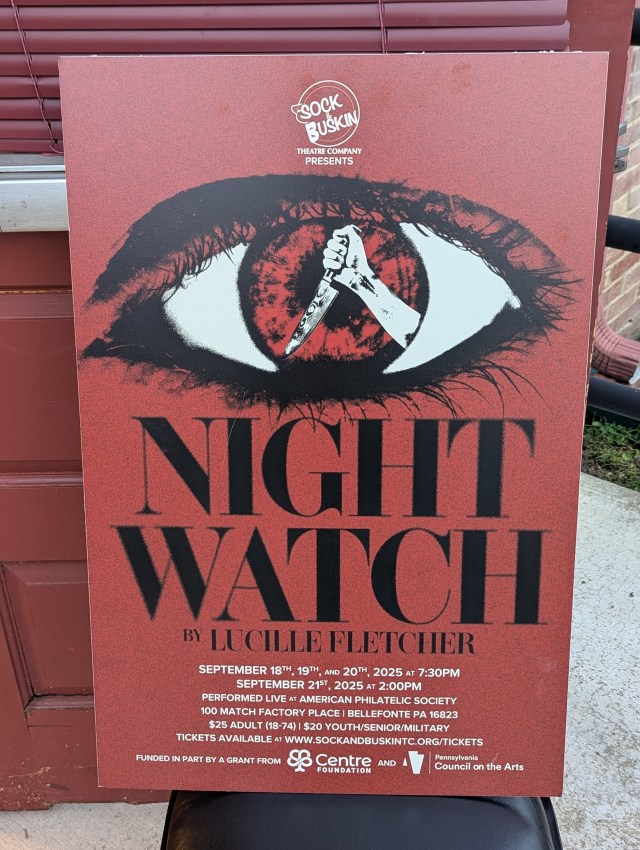
I’ve seen a good amount of professional theatre and university theatre, and both seen and been involved in a good number of community theatre productions. But I don’t know that I’ve ever seen a show as well executed as Sock & Buskin’s production of Lucille Fletcher’s Night Watch, directed by Stefanie Austin. Every beat of the show hit the perfect emotional pitch to continually built tension, right up to the terrifying last moment.
Night Watch follows Elaine Walker as she seemingly goes through an emotional breakdown. She is the sole witness to a dead body in the abandoned building across the street from her upper-class Manhattan home, but when her husband John doubts her and the police can find no trace, Elaine begins to spiral into paranoia and heightened anxiety. We learn that she has had psychological issues before, some stemming from her father’s unexpected death and some from the death of her first husband and the simultaneous revelation that he was cheating on her. Suddenly everything in Elaine’s live seems designed to taunt her with memories of the car wreck that took her first husband, or with hints that she’s going mad, or suggestions that the body wasn’t really there. When she witnesses another body in the same window and the police again find no evidence, John decides that Elaine should go to an asylum in Switzerland famous for curing insomnia and other mental illnesses. However, John also has an ulterior motive for wanting Elaine out of the country—so he can pursue his relationship with Elaine’s best friend Blanche Cooke. As everything seemingly closes in around her and the police refuse to investigate any further, the danger for Elaine seems to mount to almost unbearable levels—especially when she confronts John about a key to the opposite building that she’s found in their house. When John denies any knowledge, Elaine confronts John and Blanche about the affair before fleeing to the abandoned building to ostensibly expose the entire conspiracy. When John and Blanche follow, Elaine kills them both. In the final scene, Elaine calls the police one more time, confessing to the crime, but, as she predicted, Lt. Walker—frustrated with what he believes are her delusions—refuses to investigate, allowing Elaine to get away with the crime.
Elaine Walker has to be one of the most emotionally draining parts ever written. She’s onstage the overwhelming majority of the play and for most of that time she’s in a state of hypervigilance, paranoia, or outright terror. Despite the tremendous challenges that must come with the part, Kylie Rae Schultz hit every moment of panic, every suspicion, every moment of fear caused by the bodies or by John with absolute full force. Schultz played each emotional peak as though she were genuinely experiencing Elaine’s breakdown, which certainly helped the audience suspend our disbelief and fall into the illusion that we were seeing a real person psychologically deteriorating before our eyes. And because Schultz played the character with such intensity, she drew us into the world that Elaine has engineered. Even after finding out that Elaine masterminded every event in the play in a complex plot to kill her husband and his lover, my partner Andi still blamed John for gaslighting Elaine (even though she gaslit him)—and I can’t say I don’t feel the same way.
Playing most directly opposite Schultz was Ryan Gartland as John, a Wall Street stockbroker with little patience for his wife’s psychological need. Although not as continually on stage as Elaine, and not quite as emotionally tense, John is still an emotionally taxing performance because he spends so much time on the verge of rage if not outright enraged—and Gartland walked the line between abusive and merely frustrated masterfully. His performance consistently refused to answer the question of whether he was genuinely trying to care for his wife or whether he was actually plotting to try and destroy her mind.
The other really stunning performance was by Tom McClary as Curtis Appleby. Tom is a bit of a legend in the State College area community theatre scene—and I’ve had the tremendous good fortune to direct him before, but I’d say this was the best performance I’ve seen him give. Appleby is an eccentric neighbor who vacillates between oddball support for Elaine and sinister theorizing about the circumstances of the two bodies she’s seen. McClary brought a touch of comic relief to the role with the outlandishness of his performance—from the first moment coming on in a brightly patterned robe, two long knit scarves, and bright red gloves. But he also switched tones at a moment’s notice, turning creepy as he mused through the violent history of the building across the street or ran through theories about how the victims might have been killed.
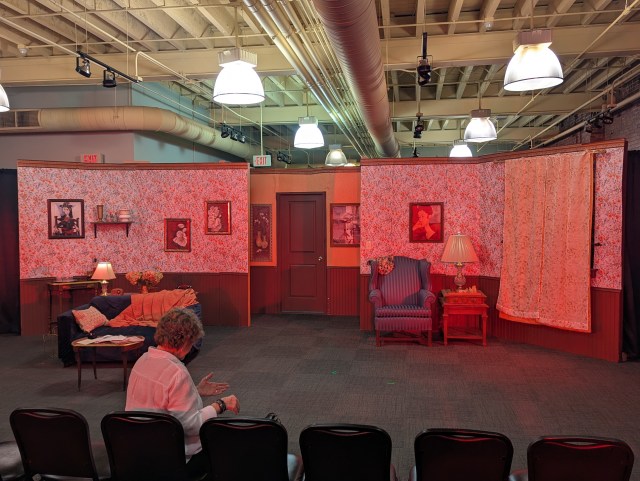
Alongside the performances, the lighting and sound played a major role in building the tension throughout Night Watch. Thrillers are somewhat easier to film than stage, in my view, because with film the camera can direct our focus where the director wants, whereas with the stage there’s less control. But Chip Taylor (sound designer) and Austin (lighting designer) used the A/V resources masterfully to help build the tension. Throughout the show, there was a near constant undercurrent of ominous music, reinforcing the anxieties and tensions created by Schultz’s performance. And the lighting work was some of the most effective I’ve seen despite the relatively limited capabilities of Sock & Buskin’s LED lights. The show opened at both the beginning and after intermission with lights up only on the grandfather clock to the far left of the stage, even as Elaine began moving around in the darkness while the clock chimed. But the real lighting pièce de resistance was the final moment of the show. Schultz returns to the stage, following Elaine’s murder of John and Blanche, with the side of her face drenched in blood. After calling the police Lt., she runs two fingers through the blood on her face and approaches the audience with a demented laugh, and just at that moment the lights go stunningly, shockingly bright red. Given Schultz being naturally pale, with dark hair and dark eyeliner that really made her eyes pop on stage, the sudden shift to sharp red made her look incredibly demonic. That lighting choice combined with the intensity of Schultz’s performance was an absolutely horrifying final image for an amazing show.
 Phillip Zapkin