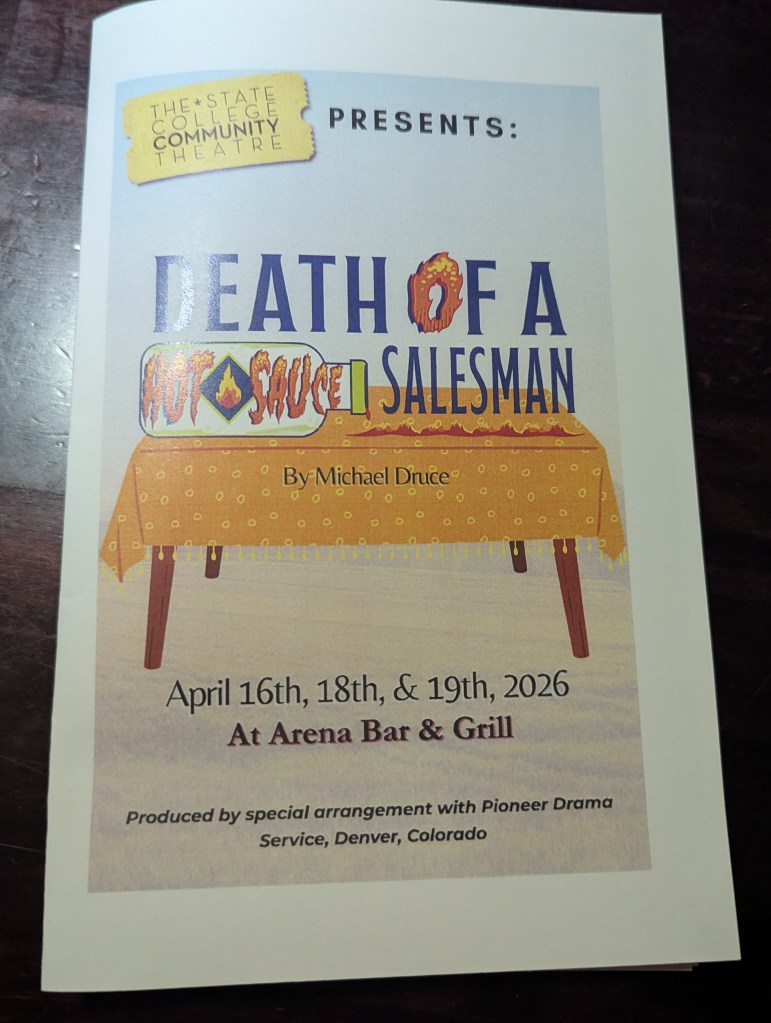
In State College Community Theatre’s production of Michael Druce’s Death of a Hot Sauce Salesman, directed by Kerry Clancy Burns, the acting far outshone the script. The performances were generally strong, but the script really didn’t give the cast and crew much to work with, being full of holes, poorly balanced, and generally a mess.
The play revolves around the murder of Prescott Knight, founder of the Hot Knights hot sauce empire, who initially suspects that someone in his family is trying to kill him. Then, when he turns up dead, his friend Judge Titus A. Drumm (who had arrived to help Prescott revise his will) investigates everyone at the family barbeque—though mainly the members of the family and house staff.
Although the script was a mess—more on that below—as I said, the actors mostly did a good job with it. Probably the most memorable was Madelyn Lippincott, playing Sassy the aptly named family maid and general servant. Lippincott brought a striking mix of sarcasm, caustic wit, and cunning servant-style observation to the role, which worked really well to fit her into the tradition of the servant who sees what the wealthy miss and speaks truth to power.
Among those with power in the show, Rod Egan (whom I’ve performed with before) did an excellent job as Prescott Knight. In particular, Rod is really good a quick emotional shifts, which happens when Prescott goes from speaking kindly to his family and praising them for their support to instantly accusing them of betrayal. The kind of sharp turn is something Rod does really effectively, and it worked extremely well for Prescott. Cassandra Poorman (with whom I’m current in a different show) playing Prescott’s granddaughter Shiloh Devereaux, gave another strong performance as the flirtatious and catty Southern belle. There was a kind of molasses quality to Cassandra’s performance, by which I mean a slow sweetness—the Southern belle aspect—combined with a kind of mean girl bitterness.
The one actor whom I was unsure about was Eric Shao, playing Brick Tarmac, prospective fiancé of Magnolia DuKane (another of Prescott’s granddaughters, played by Naliya Robinson). A big part of the problem was that his mic cut out pretty early in the show, so it was difficult to hear a lot of his dialogue. But I genuinely couldn’t tell whether Shao was such a good actor that he was convincingly playing Tarmac as a bumbling fool, or whether he was struggling to remember the lines.
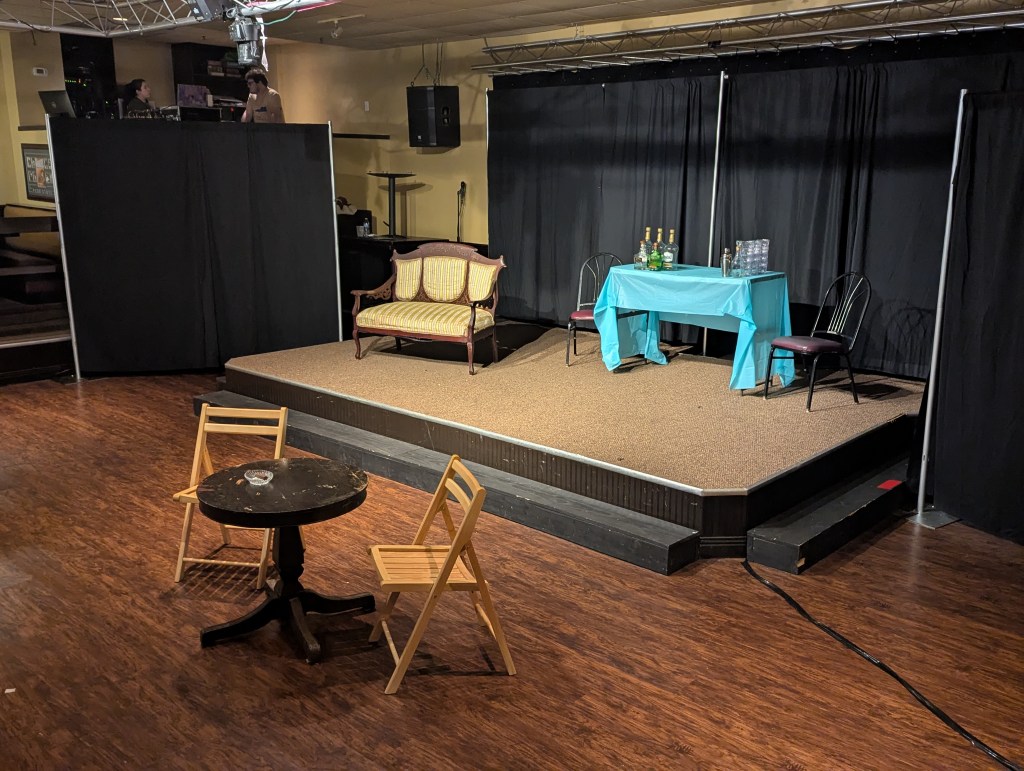
On the technical side, there were mic issues throughout the performance I saw—though most not as consistent as Shao’s mic. I can’t really criticize SCCT for this, because wireless mics are consistently finicky. I’ve had issues with them before, both as a performer and a director, so I know there’s a number of things that can go wrong with them. But losing the mics does make it difficult to hear dialogue in a space like a bowling alley bar and grill, which really isn’t acoustically designed to function well as a theatre.
But, as I said, the main issues I had with the show come down to the script. One of the tricks with writing a murder-mystery is giving the audience enough info to potentially solve the crime without giving the perpetrator away too overtly. And Death just didn’t succeed. In the first half, it’s more or less established that almost everyone has a motive to kill Prescott—he’s going to change his will in unspecified ways to potentially cut them out of inheriting his fortune and access to the secret Hot Knights hot sauce formula. So, virtually everyone has a financial motive. No help potentially solving the crime there. After the murder, Judge Drumm questions everyone and everyone provides an alibi—but the Judge never asks if anyone can corroborate any of the alibis, so all we have is the characters’ word about what they were doing. And in the second half, the judge proves that all the alibis were false. So, no help there in establishing opportunity. Basically, in order to guess correctly who the murderer or murderers are, you take a shot in the dark. The one exception to this principle is that there was a clue on the tables, but looking just at the show itself made it impossible to solve the case before the reveal.
Additionally, there were substantial plot holes and legal issues. One is that the Judge is investigating the crime. But it’s not clear that he is a trained investigator. He seems to search people’s cars and the home, either without a warrant or with a warrant he signed for himself, either of which would immediately get the case thrown out in court. And during the reveal, several characters hand him pieces of evidence (which we, the audience, didn’t have access to in the first half), meaning there’s no reliable chain of custody for that evidence—which would also get the case thrown out in court.
But perhaps more disturbing is that there’s an entirely other murder that seems completely unmotivated by anything—apart from the narrative need to establish that the perpetrator had access to Sue Rae DuKane’s (played by Jordan DeVault) gun. A character, whom we never meet, named Juan is shot. But there’s never really a compelling explanation given for why his was shot. Apart from showing that the perpetrator knew about Sue Rae’s gun—which this wealthy Southern family is shocked to learn she owned, despite the general love of guns among wealthy Southerners—it’s completely unclear what Juan had to do with anything. With the objective of solving Prescott’s murder, Juan is basically just glossed over. Similarly, Magnolia’s previous fiancé, Bo Dacious, who was actually a private investigator hired by Prescott, was also murdered roughly two months earlier, and that killing seems largely glossed over as well.

