
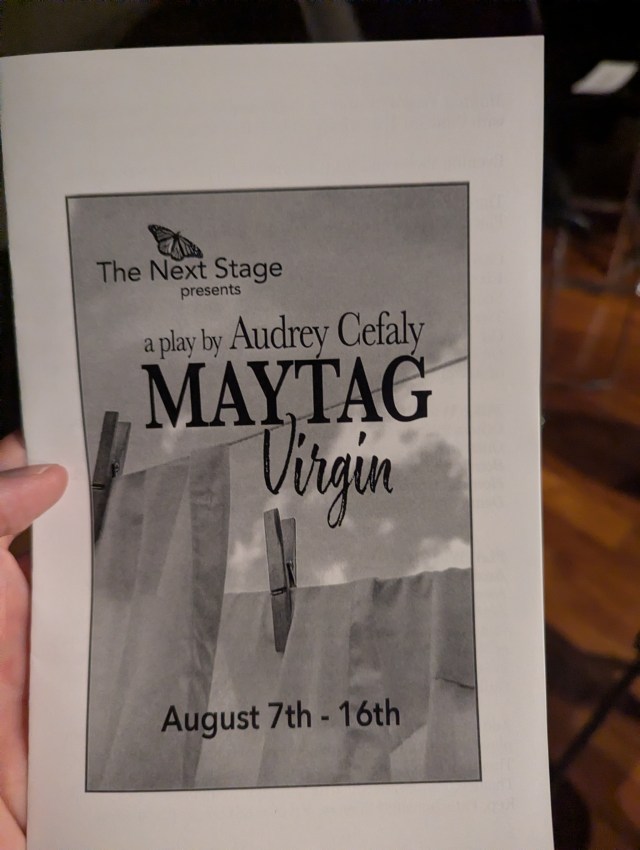
Audrey Cefaly’s Maytag Virgin isn’t the type of play I would normally be really excited about seeing, since it was billed as a romantic comedy, which isn’t my genre of choice. But in the Next Stage production, directed by Jason Zanitsch, I wanted to come out and support Mike Waldhier and Elizabeth Baptista, the two actors in the performance. And I’m really glad that I did because—as I overheard Jason describe it—the show was charming.
In the play, Jack Key has just moved to the small (fictional) southern town of Lenoraville, AL, to take a job teaching physics at the local high school. While settling in, his neighbor Lizzy Nash returns from a trip and they begin a sometimes awkward, sometimes combative, sometimes deeply emotional relationship. Over the course of a year, they clash with one another—especially about Jack leaving his dryer on his back porch—and they learn one another’s secrets and that they can lean on one another. In particular, each of the neighbors has emotional turmoil around their deceased spouses. Lizzy’s husband died a few months before in a fall from a roofing job, and while drunk with Jack she confesses that she didn’t love him and couldn’t bring herself to sleep with him, and so gave him permission to have an affair. For his part, Jack’s wife had gone through a battle with cancer, and between the period of her descent and the subsequent reminders of her in their home in MS, he had become emotionally hollowed out. Through their conflicts and confessions, the neighbors grow closer together until one night just before school starts for Jack’s second year and Lizzy’s return from bereavement leave, Jack calls Lizzy out onto the porch at 2AM and confesses his love.
The Director’s Note in the playbill for the Next Stage production emphasized that this is a show in which silences, pauses, and what isn’t said resonates at least as much as the dialogue that is spoken. Elizabeth and Mike played that balance to perfection. There were definite pauses where it was clear that emotional tension was building in the characters, but they weren’t long enough that either it felt like someone had dropped a line or that the overall speed of the performance began to drag. Pauses can be a real challenge for actors, because it’s difficult to judge during a performance how an audience will perceive the pause—whether too short to be identifiable as a pause specifically or whether too long so that the show feels slow. But Elizabeth and Mike executed the pauses and silences incredibly well to show the emotional import.
One concern that Mike mentioned (perhaps in jest) on social media when promoting the show was that we could come and judge his Southern accent, and after the show Elizabeth asked about the accents as well, so it seems to have been a worry. But the accents were really effective. Both characters clearly sounded Southern, but not to the point that it was either a caricature or had that mouth-full-of-marbles difficult to understand quality that bad Southern accents sometimes get. As with the timing, the balance of sounding authentic without going overboard was pitch perfect. And my partner Andi specifically requested that I mention that Elizabeth correctly pronounced the word Appalachia (i.e., apple-at-cha). Andi has a compulsive need to correct the pronunciation whenever someone on TV or YouTube says it wrong, so it’s a good thing that Elizabeth got it right and Andi didn’t have to correct it from the last row in the audience.
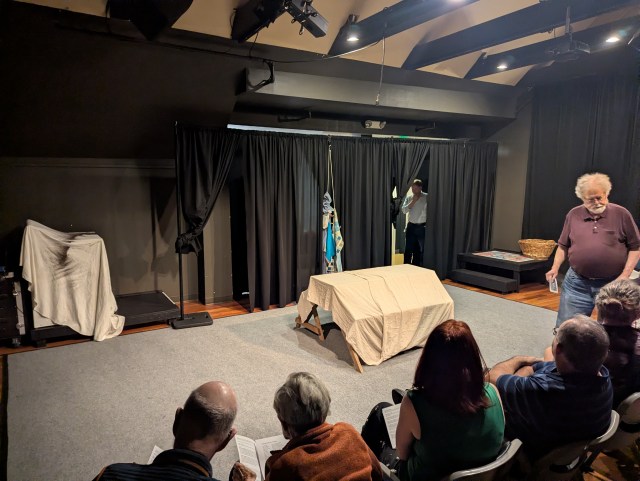
Another element that made this play so emotionally powerful was the specific performance space—the Attic in the State Theatre in downtown State College, PA. As you can see from the photo of the performance space, it’s a very small black box-style space in which the actors and audience are in extremely close proximity. This makes for an extremely intimate show, which works really well for a love story about two neighbors clashing and connecting. During intermission, I overheard Jason telling someone else in the audience that the show was meant to be performed on a bigger stage with two full houses, porches, and proper yards. But I can’t imagine the play being as emotionally impactful in a larger space or with a bigger set. Everything would likely feel too spaced out, too distant, rather than feeling a sense of immediate closeness that lent the show so much power in the Next Stage production.

