
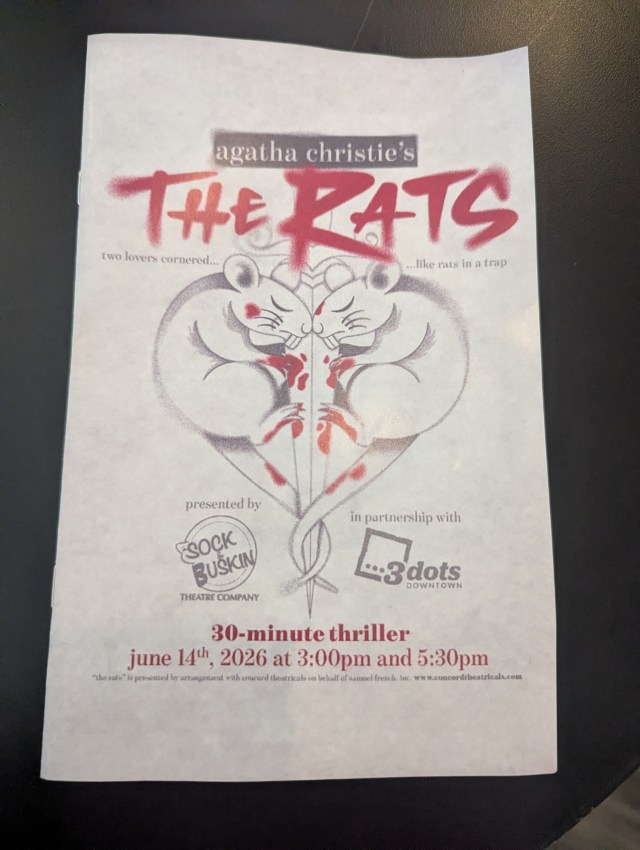
Short plays like Agatha Christie’s The Rats are always both interesting and challenging because there are some practical limitations to the story-telling, the scope, and how much time one has as an author and/or performer to bring characters to life and give them enough depth to be interesting. Sock & Buskin’s production, directed by Stefanie Austin, was a really wonderful half hour of theatre.
The play opens with Sandra Grey letting herself into the flat of some acquaintances, the Torrances, expecting to find a cocktail party in full swing. She becomes confused when Jennifer Brice arrives and explains that the Torrances are in southern France—and Jennifer tries to get Sandra to admit that she’s having an affair, then leaves shortly after David Forrester arrives. We learn that Sandra and David are, in fact, having an affair, but their both confused about why they are there. Sandra got a phone call inviting her for drinks, while David got a message ostensible from Sandra asking him to meet her there. Soon Alec Janbury shows up, an eccentric man who blames Sandra for the death of her first husband, which whom Alec was friends. Alec looks around the flat, having both David and Sandra examine a jambiya dagger before accidentally dropping it from the balcony. Alec goes down to get the knife, and when David and Sandra attempt to follow him a bit later, they find the door locked from the outside. They begin to suspect that Alec has, for reasons as yet unknown, trapped them in this flat. When they find the stabbed body of John—Sandra’s husband—is a chest Alec had drawn their attention to, they realize that they’re being framed for the murder. Alec had worn gloves while in the flat, but he specifically got both of them to touch the jambiya, meaning their fingerprints are on it but his are not, and by dropping it from the window he ensured they cannot wipe their prints. As they realize the trap they’re in, David and Sandra turn on one another, but are unable to escape while they wait for the police to arrive.
One very cool thing about S&B’s production of The Rats is that it brought three new performers to the company’s stage. Only Kari Williamson (playing Sandra Grey) has performed with S&B before. David Williams (David Forrester) has led a playwrighting workshop and had a short play of his performed by S&B, but this was his first time acting with the company, as it was for Kevin Keen (Alec Hanbury) and Eryn Pacey (Jennifer Brice). While that may not be crucial for this specific performance, it does illustrate something I love about Sock & Buskin, which is the community forward focus and the willingness to always bring in new people to expand our artistic family.
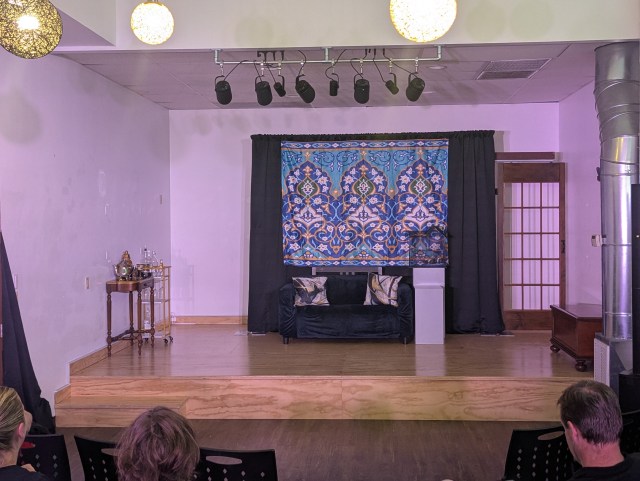
Kari and David got the most stage time, and so their performances were necessarily the most developed, with David playing a distinctly smarmy and entitled chap who clearly views Sandra as a naïve plaything, and Kari shifting between indignance, fright, and offense at David’s callous treatment of Sandra. They played well off of one another, in ways that subtly but effectively built the tension between them and showed each character to be deeply unlikable beneath surface charm. Kari brought the lack of remorse and unwillingness to accept moral responsibility for murdering her first husband to the performance, exposing the depths of Sandra’s selfishness and callousness. And for David, the specific way in which he “took command” of the situation reflected a very early-1960s version of toxic masculinity and desire to put the “little woman” in her place—The Rats premiered in 1961.
The other two performers got less stage time, which is somewhat unfortunate because I would have liked to see more from them. Eryn’s performance was somewhat constrained because it’s not entirely clear (at least to me) why Jennifer Brice is in the play at all. She serves a certain practical function of informing Sandra that the Torrances are out of the country and to introduce the thematic of Sandra’s affair, but it isn’t entirely clear that a whole character was necessary to achieve this. Nonetheless, Eryn brought a good energy as a kind of nosy neighbor type figure trying to get a gossip-worthy secret out of Sandra.
To be honest, the part I was most interested in was Alec, which I had planned to audition for before some personal things got in the way. And Kevin was quite good in the part, playing the gay-coded role with a certain degree of camp but not going over-the-top. The balance between a kind of bonhomie on the one hand while avoiding becoming cartoonish gave the performance a great flavor.
I always find Agatha Christie plays interesting, because she’s regarded as a great crime writer, but I do think that fiction was her forte. Especially with this short play, there is a kind of coherence to the plot, but there’s also a substantive plot hole, which I suspect may be a constraint of the half hour run time. Namely, Alec’s whole plan revolves around getting David and Sandra’s fingerprints on the dagger so that they will be blamed when found with John’s stabbed body. So far, so good. But, if I were a defense barrister, I would be asking some pretty pointed questions about why David and Sandra didn’t leave the flat after murdering John? I mean, if they were guilty, wouldn’t it make more sense to commit the crime and then leave? And since the answer to that question is that they were locked into the flat from the outside, I would be asking who locked them in? Since they could not have locked themselves in the room from the lock on the outside of the door, and they would have no reason to as it would thwart their potential escape, it stands to reason that someone else must have locked the couple in. Now, it is, theoretically, possible that a kindly passing stranger could have overheard the murder and taken it upon themselves to lock the door and call the police. But, again if I were a defense barrister, I would suggest that it strains credulity that someone just happened to overhear a murder in a supposedly unoccupied flat, correctly identified it as a murder, and knew how to lock the door from the outside. That sequence of events seems extraordinarily unlikely, which would support my client’s story that they’ve been framed either by Alec or by another person or persons unknown, therefore the jury must admit reasonable doubt and acquit (I’m assuming the standard of reasonable doubt applied in Britain in 1961, which may not have been the legal standard at the time).

