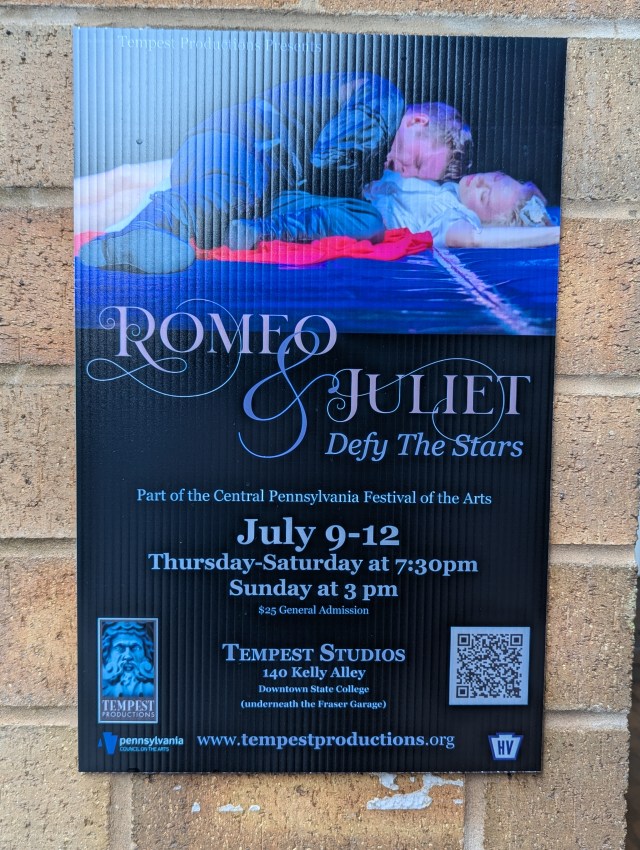
As part of the Central Pennsylvania Festival of the Arts, Tempest Productions performed Romeo & Juliet: Defy the Stars, a version of the Shakespeare play adapted by Cynthia Mazzant, founder and co-artistic director of Tempest. Most of the original Shakespearean language is there—though some is cut, often to streamline the play for a smaller company—but there are also elements repeated or Shakespearean sonnets brought in to emphasize thematic elements like the concept of fate being written in the stars. The production itself was really interesting, but the most impressive elements were the performances by Fiona Mulley (Juliet) and Drew Pirrone-Brusse (Romeo).
The adaptations Mazzant (who also played Capulet) made worked really well for making the play more focused on certain themes, and to work a bit more like modern arts theatre. The production used performance techniques like repetitions, simultaneous speaking of dialogue, a split stage, non-linear plotting, etc. to create links and parallels. Dropping the iconic prologue, the Tempest production began with Capulet’s “Death is my son-in-law” bit from near the end of the Shakespeare, setting up a non-linear timeline where Capulet has found Juliet’s diary and is struggling to make sense of the events through what she’s recorded. Alongside this non-linear structure, the play includes other repetitions, especially of Juliet’s “Take him and cut him out in little stars” bit, drawing attention to the focus on stars and fate implied in the subtitle of the production. These repetitions create thematic links between different points in the play, highlighting important points and interesting elements.
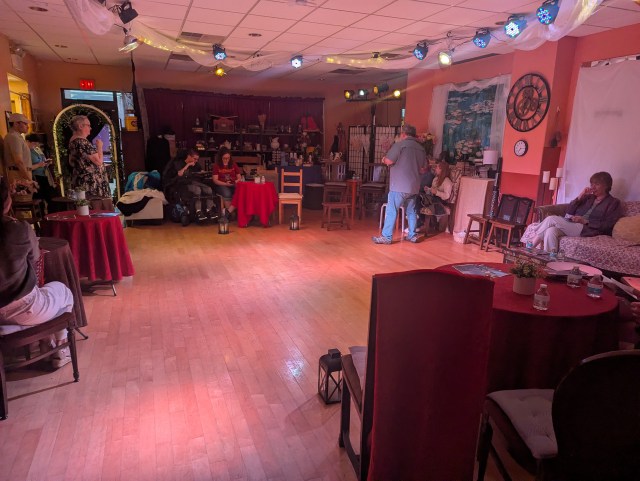
Another interesting and really effective production choice was performing the play in the round, with the performance space in the middle of the Tempest studio and seating around the outside. This meant that the actors had continual opportunities to move in circular patterns, going around one another or the space and creating visual/spatial relationships through blocking. One of the most effective examples of this was during the Capulets’ ball, when one group formed around Romeo on one side of the space and another formed around Juliet on the other. In addition to the groupings existing parallel to one another, the actors frequently spoke dialogue concurrently—either characters like Malvolio and Tybalt speaking the same lines to Romeo and Juliet respectively, or Rome and Juliet themselves saying lines simultaneously.
Beyond the textual and staging choices, however, the biggest requirement for any production of Romeo and Juliet is to have excellent actors playing the titular characters. And the Tempest Production definitely did. Fiona Mulley gave an absolutely incredible performance as Juliet. She is an incredibly talented performer—I’ve actually acted with her before in Agatha Christie’s And Then There Were None, where she played Mrs. Rogers and I played Rogers. She’s so good that it was slightly intimidating to perform with her (though some of that may be rooted in me not being as strong an actor). Fiona is one of those exceptional performers where each small change in tone of voice, facial expression, gesture, etc. adds complexity and nuance to the performance—everything seems so purposefully and perfectly chosen that if one looks away from her even for a moment one risks missing something that makes the character more interesting and complex. These subtleties were apparent throughout the performance, but probably most evident when Fiona played alongside Pirrone-Brusse, whose performance as Romeo was nearly as good. He also did an amazing job building subtlety and nuance into the character in ways that don’t always happen. The acting choices developed Romeo not just as a cavalier, emotional teen, but as someone almost hyper-reacting to the world around him in ways that reflect deep engagements with the world. As I said to Fiona after the show, I saw Romeo and Juliet performed at Shakespeare’s Globe in London in the summer of 2025, and in my view she and Pirrone-Brusse gave much better, more interesting, and more complex Juliet and Romeo performances than what I saw at the Globe.
There were a few minor issues with the production, but nothing that seriously impaired it. In a few instances, the music for the ballroom scene either started when it shouldn’t have or didn’t start quite when it should—but those are small tech issues that didn’t make much real difference. The other problem I had is a result of one of Mazzant’s cuts, but since it’s a thing I see as a problem with Shakespeare’s original version, it doesn’t bother me ultimately. After giving Juliet the potion to make her appear dead, Friar Lawrence (played by Michael Manfred in this version) is meant to send a messenger to Romeo to let him know the plan. In the Shakespeare version, the friar he sends can’t get into Mantua (where Romeo is exiled) because they’re worried about plague, but Romeo’s friend gets in to report Juliet’s death without any difficulties. In Mazzant’s cut, Benvolio (Sam Birkenthal) and Abraham (Tina Konrath) come to Romeo and tell him about Juliet’s death, and when Romeo asks about letters from Friar Lawrence, they have none to give him. Without either Friar Lawrence’s man coming and explaining that he couldn’t get into Mantua or Friar Lawrence’s recap at the end, what we’re left to conclude is that Friar Lawrence just never got around to letting Romeo know what the plan was.

